Discover practical life hacks for Nigerians designed to simplify your daily routine and improve productivity. From cost-saving ideas to smart living strategies and safety tips, this category provides easy solutions to everyday challenges. Learn how to live more efficiently, save time, and make better decisions in your daily life.
What Happens If You Die Without a Will in Nigeria?
Nobody likes to think about death. But ignoring it won’t make it go away.
If you die without a will in Nigeria, the law decides what happens to everything you own. Not your family. Not your friends. The government.
This is called dying “intestate.” And it happens more often than you think.
Here’s the hard truth: your savings, your car, your house, even your phone- all of it gets distributed according to rules you had no say in.
Let’s break down what actually happens and, more importantly, how you can prevent the headache for the people you leave behind.
What Does “Dying Without a Will” Mean in Nigeria?
When someone passes away without a valid will, lawyers call it “intestate succession.”
It simply means there are no written instructions for sharing your property. Those instructions are usually called “A Will”.
And in Nigeria, this creates a massive problem. Because without clear guidance, family members often fight over who gets what.
The worst part? The person you trusted most- your spouse, your eldest child, your best friend-has zero legal power to handle your affairs until a court says otherwise.
Nigeria Has Three Different Inheritance Systems
Here’s where it gets complicated.
Nigeria doesn’t have one single set of inheritance rules. It has three separate systems that can apply depending on your background. It all depends on your location.
1. Statutory Law (Administration of Estates Law)
This applies mainly to Christians and people married under the Marriage Act.
The Administration of Estates Law of Lagos State (2015) governs how assets are shared when there’s no will.
Under this system:
Spouse and children inherit first
Parents and siblings come next if there’s no spouse or kids
Extended relatives inherit if immediate family isn’t around
2. Customary Law
This varies by tribe and ethnic group.
Igbo custom traditionally favours male children over female children
Yoruba custom has its own rules
Hausa/Fulani custom follows different traditions
Important note: Courts have ruled that customary laws that discriminate against women may violate the Nigerian Constitution.
3. Islamic Law (Sharia)
For Muslims, inheritance follows fixed Quranic shares.
This applies mainly in northern Nigeria and operates independently of the other systems.
The catch? These systems don’t always exist separately. They can overlap.
For example: you might have a house in Lagos (statutory law), land in your village (customary law), and be Muslim (Islamic law).
Without a will, your estate gets pulled in different directions. And your family pays the price.
The First Thing That Must Happen: Letter of Administration
Here’s something most people don’t know.
Nobody automatically inherits authority over your estate. Not your husband. Not your wife. Not your eldest son.
Before anyone can touch your money, sell your property, or distribute your belongings, the court must appoint someone to manage your estate.
This happens through a Letter of Administration.
What Is a Letter of Administration?
It’s a legal document issued by the Probate Registry that grants a specific person the power to handle your affairs.
Without this document, no one has the legal right to:
Access your bank accounts
Sell your property
Transfer your shares
Distribute your belongings
Until the Letter of Administration is obtained, your estate legally belongs to the Chief Judge of your state.
Who Can Apply for a Letter of Administration?
The law sets a clear order of priority.
Surviving spouse – first in line
Children – or grandchildren of a child who died before you
Parents – your father or mother
Siblings – brothers and sisters of full blood
Half-siblings – brothers and sisters of half-blood
Grandparents – your grandfather or grandmother
Uncles and aunts – of full blood, or their children
Creditors – people you owe money to (in limited cases)
Administrator General – if nobody else qualifies
Real talk: This order doesn’t always prevent conflict. Multiple family members often fight over who should be the administrator.
How to Get a Letter of Administration (Step by Step)
If you find yourself in this situation, here’s what to do.
Step 1: Confirm there’s no valid will
Check everywhere. If a will exists, you don’t need a Letter of Administration.
Step 2: Determine who’s eligible to apply
Check the priority order above. The person highest on the list should apply.
Step 3: Visit the Probate Registry
Go to the Probate Registry in the state where the deceased lived.
Step 4: Get and fill in the required forms
You’ll need:
Application for grant of Letter of Administration
Oath of Administration
Administration Bond
Declaration as to Next of Kin
Inventory of assets
Schedule of debts and funeral expenses
Sureties’ Application Form
Step 5: Gather supporting documents
Death certificate
Passport photos of the deceased
Passport photos of all proposed administrators and sureties
Step 6: Submit and pay the fees
The court will review your application. If everything checks out, they’ll issue the Letter of Administration.
The Life Hack: Write a Will (It’s Easier Than You Think)
Here’s the truth: everything above is avoidable.
You can bypass all this court drama by writing a simple will.
What Makes a Will Valid in Nigeria?
Must be in writing
You must be at least 18 years old
You must be of sound mind
At least two witnesses must sign it
What Happens If You Have a Will?
Your appointed executor (not the court) handles your affairs.
Then your assets go exactly where you want them to go.
This prevents your family from fighting over who’s in charge.
It’s that simple.
What Most Nigerians Get Wrong About Wills
Myth #1: “Wills are only for rich people.”
False. Your savings account, car, and personal belongings are worth protecting.
Myth #2: “Writing a will means I’m going to die soon.”
Nonsense. It means you’re being responsible.
Myth #3: “My family will automatically know what to do.”
They won’t. And they’ll probably fight about it.
Myth #4: “I’m too young to need a will.”
If you own anything of value, even a bank account, you need one.
What Happens to Your Assets Under Statutory Law?
Here’s the breakdown for young, single Nigerians:
If you have a spouse and children: They inherit everything
If you have no spouse or children: Your parents inherit
If your parents are dead: Your siblings inherit
If no immediate family exists: Extended relatives inherit
But remember: If you’re governed by customary or Islamic law, the rules change completely.
The same person’s assets could be divided three entirely different ways depending on their background.
The Cost of Not Planning
Let me be blunt.
When you die without a will in Nigeria:
Your family will go to court – costing time and money
Your assets will be frozen – nobody can access them
Your business could collapse – no one has authority to make decisions
Your loved ones will fight – over things you never wanted them to fight about
The government decides – not you, not your family
That’s not how you want to be remembered.
Quick Action Steps (Do This Today)
List everything you own – bank accounts, property, investments, vehicles
Decide who gets what – be specific
Choose an executor – someone you trust to carry out your wishes
Visit a lawyer – to draft a valid will (it’s affordable)
Sign it with two witnesses – and keep it somewhere safe
Tell your family where to find it – don’t leave them guessing
Final Thought
You have the power to change that.
Not your spouse, children, nor parents.
The law, written decades ago, will determine who gets everything you worked for.
You have the power to change that.
A simple will costs less than a dinner out. But it saves your family from years of court battles, legal fees, and broken relationships.
Don’t leave your loved ones with a mess to clean up.
Write your will. Protect your family. Control your legacy.
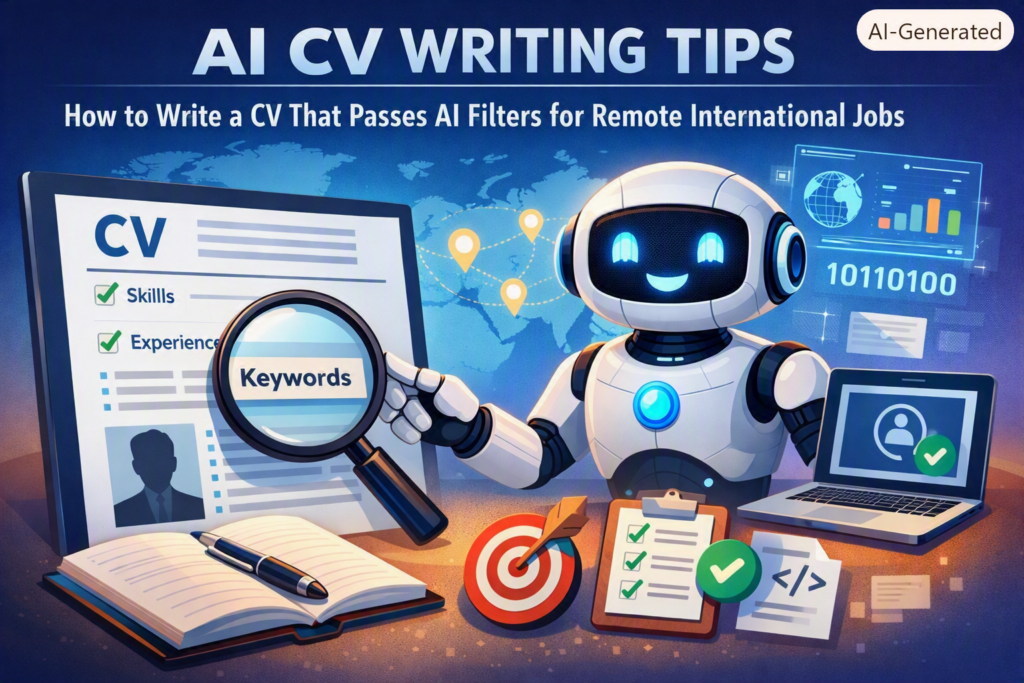
Wondered if your CV might be why you haven’t been getting responses to your job applications?
You spent hours on your CV. You hit send. Then… nothing.
Here’s the uncomfortable truth. A human may never even see that CV. A robot read it first, and it said no.
That robot is called an ATS, short for Applicant Tracking System. Almost every remote job now runs your CV through one before a real person looks at it. If your CV isn’t built for that, you’re invisible no matter how good you are.
Good news: this isn’t a mystery. Once you know how these systems think, you can write a CV that passes AI filters every single time.
Let’s fix this together.
What Is an ATS and Why Should You Care?
Think of an ATS like airport security for your job application.
It scans your CV, looks for keywords, checks your formatting, and decides if you’re worth a second look. No stamp of approval, no interview.
This matters even more for remote international jobs. Companies hiring across borders get flooded with applications. They rely on AI filters more than local companies do to manage volume.
So your CV isn’t competing with 20 people anymore. It’s competing with 2,000. The ATS is the bouncer deciding who gets in.
The Biggest Mistake People Make With Their CV
Most people design their CVs to look pretty first and to be readable by AI second.
That’s backwards.
Fancy templates with columns, graphics, and creative layouts often confuse the software. It can’t read text trapped in a text box, and it skips tables. Then, it ignores headers stuffed inside images.
Your beautiful, designer CV might be landing in the trash folder, unread, simply because a machine couldn’t parse it.
How to Format Your CV So the AI Actually Reads It
Keep this part boring on purpose. Boring works.
Use a single-column layout, not two or three
Stick to standard fonts like Arial, Calibri, or Georgia
Avoid text boxes, headers, footers, and tables
Save your file as a .docx or a text-based PDF, never an image-based PDF
Use simple section titles like “Work Experience,” not “My Journey”
That last point matters more than people think. ATS software is trained to recognise common labels. If you get creative with your titles, it may skip the section entirely.
Quick Life Hack: The Copy-Paste Test
Here’s a fast way to check if your CV is ATS-friendly.
Open your CV file. Select all the text. Copy it. Paste it into a plain notepad or text file.
If everything shows up in the right order and nothing is missing, you pass. If the text is jumbled or sections are missing, an ATS will struggle too.
This takes two minutes and saves you from silent rejections.
Keyword Matching: The Real Secret to Beating AI Filters
This is where most job seekers lose the game without knowing it.
ATS software scans your CV for keywords that match the job description. No match, no interview, even if you’re perfect for the role.
How to Find the Right Keywords
Open the job posting you want to apply for
Highlight every skill, tool, and qualification they mention
Note repeated phrases, like “cross-functional teams” or “remote collaboration”
Use those exact phrases in your CV, not synonyms
If the job says “project management,” don’t write “team coordination.” Say “project management.” The AI is matching text, not reading your mind.
The Mirror Trick
Here’s a simple hack that works fast.
Keep the job description open next to your CV while you edit. Literally mirror their language back at them, section by section.
If they ask for “stakeholder communication,” use that exact term in your experience bullet points. This single habit can double your callback rate for remote roles.
Writing for Remote and International Roles Specifically
Remote job CVs need a few extra touches that in-office CVs don’t.
Companies hiring remotely want proof you can work independently across time zones. Say that clearly; don’t just imply it.
Mention specific tools you’ve used: Slack, Zoom, Asana, Notion
Include time zones you’ve worked across, if relevant
Add a line about async communication or self-management
Skip your full home address; a city and country are enough for international applications
Recruiters searching “remote job resume tips” are usually looking for exactly this. Global hiring teams want candidates who don’t need hand-holding.
Should You List Your Location Differently for Global Jobs?
Yes, and this trips people up constantly.
Skip your street address completely. List your city and country only, like “Lagos, Nigeria” or “Berlin, Germany.”
This protects your privacy. It also signals to the recruiter and the ATS that you’re already thinking globally, not locally.
A Simple Checklist Before You Hit Submit
Run through this list every time before you apply:
File saved as .docx or text-based PDF
Single column, no tables or text boxes
Standard section headers used
Keywords from the job post mirrored in your bullet points
Job titles match industry standard terms
Remote-specific skills clearly listed
Contact info includes city, country, email, and LinkedIn
Five minutes with this checklist can be the difference between a reply and silence.
A Word on Fairness and How AI Screening Actually Works
It’s worth knowing that using an ATS to screen candidates isn’t something companies are required to disclose in most cases.
Some countries are starting to introduce rules around automated hiring decisions, especially in the EU. But enforcement varies a lot, and most job seekers won’t ever know exactly how a company’s filter is set up.
The safest move is not to fight the system. Write a CV so clean and keyword-matched that it sails through, no matter which software is on the other end.
Finally
Getting your CV past AI filters isn’t about tricking anyone. It’s about speaking the same language the software understands, then letting your real experience shine once a human sees it.
Keep it simple. Mirror the job posting. Test your formatting. Do this consistently, and you’ll start getting more replies from remote and international employers.
Can You Sue Someone for Breaking a Promise to Marry? Here’s What the Law Really Says
You spent years building a relationship.
Your families knew each other. Wedding plans had started. Money had been spent. Then, without warning, your fiancé or fiancée called everything off.
Now you’re left asking one question:
Can I sue this person for breaking their promise to marry me?
The short answer is yes, but not always.
The law does not force anyone to marry against their will. Marriage is a voluntary union. However, where someone makes a genuine promise to marry, causes the other person to rely on that promise, and later walks away without lawful justification, the law may allow the injured party to seek compensation.
The answer depends on the facts, the evidence, and the country whose laws apply.
Let’s unpack what the law really says.
Is a Promise to Marry Legally Binding?
Many people assume that an engagement is merely a romantic commitment with no legal consequences.
That isn’t entirely true.
Although an engagement is not the same as marriage, it can create legal obligations under certain circumstances.
The courts generally recognise that a promise to marry is more than casual dating when there is clear evidence that both parties genuinely intended to marry each other.
The law does not punish someone simply because they changed their mind.
Instead, it examines questions such as:
Was there actually a promise?
Was the promise serious?
Did the other person rely on that promise?
Did the breakup cause measurable financial or emotional loss?
Those questions often determine whether a lawsuit can succeed.
The Law Doesn’t Force Marriage
This is perhaps the most important point.
No court can order someone to marry another person.
Marriage requires free and voluntary consent.
Even if someone clearly promised to marry you, the court cannot compel the wedding to take place.
Instead, where appropriate, the court may award financial compensation for losses resulting from the broken promise.
What Is a Breach of Promise to Marry?
A breach of promise to marry occurs when:
one person makes a genuine promise to marry another,
the other person accepts that promise,
wedding plans progress or significant reliance occurs,
and one party later refuses to marry without lawful justification.
This type of claim has existed in many legal systems for centuries, although several countries have abolished or restricted such actions.
Ezeanah v. Atta (2004) 11 NWLR (Pt. 884) 464: The Supreme Court (per Niki Tobi, JSC) ruled that a mere romantic relationship or “whispering of sweet nothings” is not enough to establish a promise. The agreement must be concrete and leave no one in doubt. However, the court held that a written agreement is not required; a promise to marry can be inferred from the parties’ conduct.
What Does Nigerian Law Say?
In Nigeria, a breach of promise to marry can still give rise to a civil action.
However, winning such a case is far from automatic.
The person bringing the lawsuit must convince the court that:
there was a genuine promise to marry;
both parties intended marriage;
the defendant broke that promise;
The claimant suffered actual damage because of the broken promise.
Courts examine each case individually.
No two cases are exactly alike.
What Evidence Can Prove a Promise to Marry?
This is where many cases succeed—or fail.
Simply saying,
“He promised to marry me,”
is rarely enough.
Strong evidence may include:
Engagement ceremonies
Traditional introductions or engagement ceremonies often strengthen a claim that marriage was genuinely intended.
Wedding preparations
Evidence may include:
venue bookings
bridal payments
wedding invitations
deposits paid to vendors
receipts
photographs
These documents demonstrate that the relationship had moved beyond casual dating.
Messages and Emails
Text messages can become powerful evidence.
For example:
“I can’t wait for us to get married next December.”
or
“Let’s begin paying for our wedding.”
Such conversations may support the existence of a promise.
Witnesses
Family members.
Friends.
Religious leaders.
Anyone who witnessed the engagement or discussions about marriage may provide useful testimony.
Can You Claim Emotional Distress?
Many people suffer serious emotional pain after a broken engagement. The law recognizes that heartbreak can have significant consequences.
However, courts generally require more than sadness or disappointment. They look for evidence of actual harm, such as:
financial losses
humiliation
reputational damage
psychological injury supported by evidence
The stronger the proof, the stronger the claim.
Can You Recover Money Spent on the Wedding?
Possibly.
Suppose you paid for:
wedding decorations
catering
photography
honeymoon reservations
wedding attire
invitation cards
If those expenses became wasted solely because the other party unjustifiably backed out, the court may consider awarding damages. Every expense should be supported with receipts or other evidence.
What If Someone Cheats Before the Wedding?
Suppose your fiancé develops another relationship shortly before the wedding.
Does that automatically mean you can sue? Not necessarily.
The issue is not simply infidelity.
The court asks whether the conduct amounted to an unjustified breach of the promise to marry.
Each situation depends on its unique facts.
What If There Was No Formal Engagement?
A ring is not always necessary.
Some couples never hold formal engagement ceremonies.
Others never exchange rings.
That alone does not destroy a legal claim.
What matters is whether there is convincing evidence that both parties genuinely agreed to marry.
Can Parents Sue?
Usually, no.
The right belongs to the person whose promise was broken.
Parents generally cannot sue merely because they spent money or suffered embarrassment, unless the law provides another independent basis for their claim.
When a Court May Refuse Your Claim
Not every broken engagement leads to compensation.
A court may reject the claim where:
there was never a genuine promise;
both parties mutually agreed to end the relationship;
the claimant cannot produce evidence;
the defendant had lawful reasons for ending the engagement;
The alleged promise was vague or uncertain.
The burden of proof rests on the person bringing the lawsuit.
Practical Steps to Take Before Filing a Lawsuit
If you believe someone unlawfully broke a promise to marry, avoid acting out of anger.
Instead:
1. Preserve every piece of evidence.
Keep messages.
Emails.
Receipts.
Photographs.
Voice recordings, where lawfully obtained.
2. Write down the timeline.
Record important dates while events remain fresh in your memory.
3. Calculate your financial losses.
List every expense connected with the planned marriage.
Attach receipts wherever possible.
4. Speak to a lawyer early.
A lawyer can assess whether your evidence supports a viable legal claim before you spend money on litigation.
5. Consider settlement.
Court proceedings can be lengthy and emotionally draining.
Sometimes a negotiated settlement protects everyone’s interests better than a courtroom battle.
Frequently Asked Questions
Can someone be arrested for breaking a promise to marry?
Generally, no.
Breaking a promise to marry is usually a civil matter rather than a criminal offence. However, if the circumstances involve fraud, obtaining money by deception, or another criminal act, separate legal consequences may arise.
Is an engagement ring legally recoverable?
It depends on the circumstances and the applicable law. Courts may consider whether the ring was an unconditional gift or one given in contemplation of marriage.
Is there a time limit for bringing a claim?
Yes. Civil claims are generally subject to limitation periods, which vary depending on the jurisdiction. Seeking legal advice promptly is important to avoid missing any applicable deadline.
How to Renew Nigerian Passport Online in 2026 (No Agent Needed)
The ₦150,000 Lesson Nobody Should Have to Learn
Chukwuemeka had six weeks before his visa interview at the British High Commission in Lagos.
His passport expired eight months earlier. He knew he needed to renew it. He just kept postponing — work, kids, the general chaos of Lagos life. Then the appointment letter arrived and panic set in.
A colleague at the office smiled. “Don’t worry. I know a guy.”
The guy charged ₦150,000. Cash. Promised delivery in two weeks. Collected the money, the old passport, and Chukwuemeka’s birth certificate. Then disappeared for three weeks, calls diverting, WhatsApp ticks stubbornly grey.
The passport eventually came. One day before the visa interview. Two weeks late. With a data page error that took another week to fix.
The entire process from start to finish took 47 days and cost ₦150,000 for a 32-page booklet (5-year validity), plus a rescheduled visa appointment fee.
The official online process, when done correctly, takes the same amount of time. Costs a fraction. Requires zero middlemen.
This is that guide.
Why People Still Pay “Run-Men” in 2026
Let’s be honest about this.
The Nigerian Immigration Service (NIS) has had an online passport application portal for years. It works. It is not perfect; no government portal in any country is, but it is functional, and millions of Nigerians have used it successfully without paying a single kobo to an agent.
The run-man economy survives for three reasons.
One: People don’t know the exact process and are afraid of making expensive mistakes with government forms.
Two: The portal has quirks such as browser compatibility issues, payment gateway hiccups, and document upload requirements that aren’t clearly explained, which frustrate first-timers into giving up.
Three: Agents are everywhere at passport offices, and they are very good at creating the impression that without them, nothing will move.
None of these is a reason you need to pay anyone.
What you need is the correct information, in the right sequence. That is what this post gives you.
Before You Start: Know Which Process Applies to You
Not all passport renewals follow the same path. Get this wrong and you waste time.
Standard Renewal (most people): Your passport has expired or will expire within six months. You are in Nigeria. You want a new 32-page or 64-page booklet. This is the online process we are covering in detail.
Renewal Abroad: You are outside Nigeria. The process runs through Nigerian Embassies and High Commissions, although some now offer online pre-application, and physical appearance is still required at the mission. This guide does not cover that route fully so contact your nearest Nigerian mission for their specific procedure.
Emergency/Express Passport: For genuine emergencies, a death abroad, a medical trip, or imminent travel within 72 hours, the NIS has an emergency procedure. It costs more and requires physical appearance with supporting documents. An agent cannot speed this up; the NIS controls the timeline entirely.
Lost or Stolen Passport: A different process involving a police report, affidavit, and additional documentation. Do not use the standard renewal portal for a lost passport. Confirm which category applies to you before you proceed.
What You Need Before You Open the Portal
Gather everything first. Half the people who abandon the portal midway do so because they didn’t have a document ready and lost their session.
Documents required:
Current or most recent expired Nigerian passport (you will need the passport number and biodata details)
National Identification Number (NIN) — this is now mandatory. No NIN, no passport. Full stop.
Valid means of identification (National ID card, driver’s licence, or voter’s card)
Birth certificate or age declaration (for first-time applicants; renewals typically don’t require this unless specifically requested)
Passport photographs — white background, recent, taken within the last three months. The portal allows photo upload but you will also bring physical copies to the appointment.
Technical requirements:
A working email address you actually check — all portal communications go here
A working Nigerian phone number for OTP verification
A debit card or bank account for online payment (Mastercard, Visa, or Verve — all work on the NIS portal)
A laptop or desktop computer. Do the application on a PC, not a phone. The portal is not mobile-optimised and phone sessions time out aggressively.
Use Google Chrome or Mozilla Firefox. Internet Explorer and Safari create compatibility problems. Stick to Chrome.
Step-by-Step: The Exact Online Renewal Process
Step-by-Step: The Exact Online Renewal Process
Step 1: Go to the Official NIS Portal — And Only the Official Portal
The official Nigerian Immigration Service passport portal is:
Bookmark it. Screenshot it. That URL is the only one you should use.
There are clone sites, some convincing, some obviously fraudulent, that harvest your personal data and payment details. They rank on Google and look official, but they are not.
If a site asks for your NIN, date of birth, passport number, and payment information but the URL does not match the official NIS domain, close it immediately.
Step 2: Create Your Account
Click “Apply Now” and select “New Applicant” if you have never used the portal before, or “Existing Applicant” if you have a previous account.
For a new account, you will provide:
Full name (exactly as it appears on your existing passport and NIN)
Email address
Phone number
A password
An OTP will be sent to your phone number for verification. Enter it within the time window, it expires quickly. If it doesn’t arrive within 60 seconds, use the resend option once. If it still doesn’t arrive, check that the phone number you entered is correct and active.
Once verified, your account is created. Log in immediately and complete your profile before doing anything else.
Step 3: Start Your Application — Select the Right Options
After logging in, click “Apply for Passport” and select:
Application Type: Renewal
Passport Type: Standard (for the regular green booklet)
Booklet Type: 32 pages or 64 pages
Which booklet should you choose?
If you travel frequently, more than three or four times a year, or to multiple countries, go for 64 pages. The fee difference is modest and running out of visa pages is an avoidable frustration. If you travel rarely, 32 pages is sufficient.
Step 4: Fill the Application Form — Carefully and Exactly
This is where most errors happen.
The form asks for your biodata: name, date of birth, place of birth, state of origin, local government area, gender, and contact details. Every single entry must match your NIN record exactly.
This is not a suggestion. It is a requirement.
The NIS system cross-checks your application data against the NIMC (National Identity Management Commission) database in real time. A name discrepancy, even a missing middle name or a different spelling, will flag your application and may result in rejection or delays at the passport office.
If your NIN record has an error, fix it at NIMC before you apply for the passport. Trying to work around it in the passport application will not end well.
Additional form sections include:
Next of kin details — name, address, relationship, phone number
Guarantor information — a Nigerian citizen with a valid passport who can vouch for your identity. For renewals, this requirement is less strictly enforced than for first-time applications, but have the details ready.
Previous passport details — enter your current or most recently expired passport number, issue date, and place of issuance exactly as printed in the passport.
Review every field twice before proceeding. You cannot easily edit a submitted application.
Step 5: Upload Your Photograph
The portal requires a digital passport photograph upload meeting the following specifications:
White background — not cream, not grey, not light blue. White.
Full face, front-facing, no glasses, no head covering (except for religious reasons)
Neutral expression, mouth closed
File format: JPEG or JPG
File size: between 10KB and 50KB
Dimensions: approximately 200 x 200 pixels
Practical tip: Have a photographer take your passport photo and ask them to give you a white-background digital copy on a USB drive or via WhatsApp. Many passport photographers in Nigeria now provide digital copies as standard. Confirm the file size before you leave their shop. Photos larger than 50KB will be rejected by the portal, and you will need to compress and re-upload them.
Free online tools like ilovephoto.com or Compress JPEG can reduce file size without significantly affecting quality.
Step 6: Select Your Passport Office and Appointment Date
After submitting your form and photo, you will select:
The NIS passport office where you will appear for biometric capture
Your preferred appointment date and time slot
Choose your passport office wisely. Major offices, Ikoyi (Lagos), Abuja headquarters, Port Harcourt have higher application volumes, and appointment slots fill up quickly. If you are in Lagos and flexibility allows, consider selecting a less congested office in Ikeja or even Ikorodu, where appointment availability is often better.
Select the earliest available slot that works for your schedule. Do not book an appointment you cannot keep; rescheduling is possible but adds unnecessary delay.
Screenshot your appointment confirmation immediately. The system will also send it to your email, but government portal emails sometimes land in spam. Check your spam folder.
Step 7: Pay the Official Fee
After selecting your appointment, you will be directed to the payment page.
Official NIS passport fees (as of 2026):
32-page standard passport: ₦100,000
64-page standard passport: ₦200,000
These are the official government fees. You pay them on the portal. You pay them nowhere else.
Payment methods accepted on the NIS portal:
Debit card (Mastercard, Visa, Verve)
Internet banking (via Remita — the government’s payment gateway)
Bank branch payment (Remita Reference Number generated on portal, paid at any commercial bank)
If your card payment fails on the first attempt, which happens because Remita can be temperamental — wait five minutes and try again. Do not attempt the payment multiple times in quick succession; multiple deductions can occur and reversals take time.
If you prefer to avoid card issues entirely, use the Remita Reference Number route: generate the reference on the portal and walk into any GTBank, Access Bank, Zenith Bank, or First Bank branch to pay cash over the counter. Bring the reference number printed or on your phone. The payment reflects on the portal within 24 hours.
After successful payment, download and print your payment receipt and your application summary. Both go with you to your appointment.
Step 8: Attend Your Appointment
On your appointment day, arrive at the passport office at least 30 minutes early.
Bring the following in a neat folder, not stuffed in a bag:
Printed appointment confirmation slip
Printed payment receipt
Completed application summary printout
Current or expired passport (original)
NIN slip or National ID card (original)
Two recent passport photographs (physical copies, white background)
Any other supporting documents specified during your application
At the passport office, you will go through:
Document verification — an NIS officer checks that your documents match your online application
Biometric capture — fingerprints (all ten fingers) and a live photograph
Data confirmation — you review your data on screen and confirm it is correct
This entire process at the office typically takes 30 – 90 minutes if you arrive at your scheduled time with complete documents. If your documents are incomplete, you will be turned away and required to reschedule. There is no “managing” your way through with incomplete paperwork.
Important: Do not bring cash to “assist” the process. Officers who solicit bribes can be reported to the NIS Public Complaints Unit. The process is designed to work without facilitation payments. If an officer suggests otherwise, note their name or badge number.
Step 9: Track Your Application
After your biometric appointment, your passport goes into production.
Track the status of your application on the NIS portal:
https://passport.immigration.gov.ng → Login → Application Status
Status updates move through: Submitted → Biometrics Captured → Processing → Ready for Collection / Dispatch.
Realistic production timelines in 2026:
Standard processing: 4 – 6 weeks from biometric appointment
Express processing: 2 – 3 weeks (where available — check with your specific passport office)
These timelines assume no data issues, no system backlog at the NIS booklet production centre, and no public holidays clustering in that window. Practically, allow eight weeks from appointment to collection if you want a stress-free buffer.
Step 10: Collection or Delivery
You have two options for receiving your completed passport:
Option 1: Collect at the passport office: You receive an SMS and/or email notification when your passport is ready. Return to the office with your collection slip and a valid ID. Collection is usually straightforward.
Option 2: Home delivery via NIPOST: The NIS offers a home delivery option through NIPOST (Nigerian Postal Service) at an additional fee selected during the application. Delivery covers most Nigerian states, but timelines vary significantly by location. Lagos and Abuja deliveries are generally faster than remote states.
If you opt for delivery, ensure your address is precise — street name, house number, landmark. NIPOST delivery agents will not search for you. A wrong address means a returned passport and a collection trip anyway.
The Most Common Portal Problems — And How to Fix Them
Problem: “NIN not found” error during application
Fix: Verify that your NIN is active and your NIMC record is updated. Visit any NIMC enrolment centre with your NIN slip and valid ID to confirm your record is complete.
Problem: Payment deducted but portal shows “payment pending”
Fix: Wait 24 hours for Remita to reconcile. If it doesn’t clear, take your bank debit alert and payment reference to the NIS passport office on your appointment day — the accounts desk can manually verify and clear the payment.
Problem: Photo upload rejected
Fix: The file size or background colour is almost certainly the issue. Use an online compression tool to bring the file under 50KB and ensure the background is pure white (RGB 255, 255, 255).
Problem: Appointment slots show as fully booked
Fix: Check back early in the morning; slots are released on a rolling basis, and cancellations free up slots daily. Alternatively, try a different passport office within a reasonable distance.
Problem: Portal times out mid-application
Fix: Use Chrome, clear your cache before starting, and type all your information in a Word document so you can paste quickly. Avoid applying on mobile data. A stable WiFi or broadband connection reduces timeout risk significantly.
What the Run-Man Cannot Do That You Think He Can
Let’s put this to rest.
A passport agent, the legitimate kind, not the fraudulent ones, is essentially just a person who knows the process and completes it on your behalf. They have no special access to the NIS system and don’t have a back channel that accelerates production; neither can they jump the biometric queue for you. The passport production timeline is the same whether you applied yourself or paid someone to do it.
What they do is fill in the online form, book the appointment, and escort you to the office. That is it. You can do all of that yourself in about 45 minutes with this guide. The only thing an agent “speeds up” is the part where you have to think. And thinking, in this case, is free.
One Final Word Before You Close This Tab
Start the process today.
Not when your passport is about to expire. Not when you have a trip booked. Today! Right now, while the information is fresh and the motivation is present.
The entire online process takes less than an hour to complete. The appointment and production time runs on the NIS clock, not yours, and that clock does not start until you apply.
Every week you wait is a week added to the end of your timeline. And the agent is counting on that delay. He is banking on your procrastination turning into his commission.
Don’t give it to him.
Have questions about a specific step or a portal error you’ve encountered? Drop it in the comments. If I’ve seen it — and I’ve seen most of them — I’ll tell you exactly how to fix it.