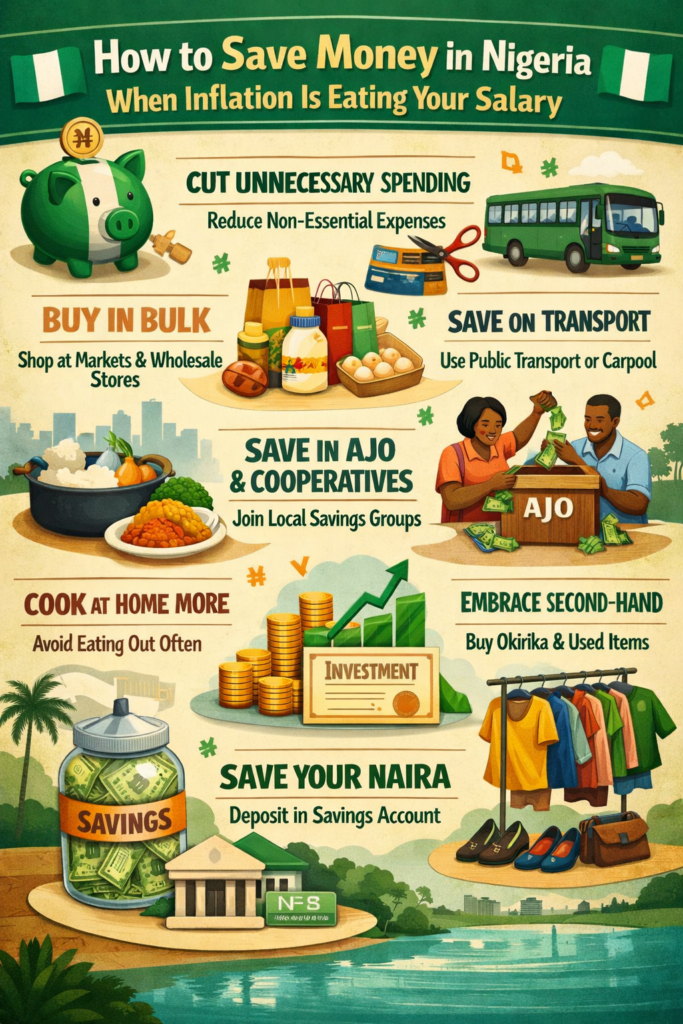
How to Save Money in Nigeria in 2026 (When Your Salary Is Not Enough)
Tolu earns ₦180,000 a month.
Two years ago, that salary felt manageable. Rent, food, transport, a little left over. Not rich but stable. Breathing room existed.
Today, the same ₦180,000 arrives on the 25th and is functionally gone by the 10th of the following month. Nothing changed in her lifestyle. Everything changed around it.
A bag of rice that cost ₦28,000 in 2023 now costs ₦75,000. Cooking gas that was ₦5,000 per cylinder is ₦18,000. Her transport fare to work doubled; the landlord added 60% to her rent renewal, and her salary went up by ₦20,000 only.
The mathematics of Nigerian inflation is not complicated. It is just brutal.
Here’s the truth: saving money in Nigeria in 2026 is not about cutting your morning coffee. It is about restructuring how money moves through your life, before inflation takes it. This post gives you the exact framework to do that.
First, Understand What You’re Actually Fighting
Before any strategy makes sense, you need to understand the enemy clearly.
Nigeria’s inflation is not a temporary blip. It is structural — driven by naira depreciation, fuel subsidy removal, import dependency, and food supply disruptions. The Central Bank of Nigeria has been raising interest rates to combat it, but monetary policy alone cannot fix supply-side problems.
What this means practically: the naira you hold today is worth less tomorrow. Consistently. Predictably. Which means the traditional Nigerian savings advice — “keep money in your savings account” — is actively working against you.
A savings account paying 4% interest while inflation runs at 30%+ is not saving. It is a slow leak.
Your strategy must do two things simultaneously: reduce what inflation takes from you and store value in forms that inflation cannot easily destroy. Everything in this post does one or both.
Part One: Stop the Bleeding — Fix Your Spending Architecture
The “Salary Ambush” Problem
Most Nigerians don’t overspend deliberately. They get ambushed.
The salary lands. Someone needs money. A bill arrives. Fuel runs out, then an emergency surfaces. By the time you think about saving, there is nothing left to save.
This is not a discipline problem. It is a structural problem. And structural problems need structural solutions.
Pay Yourself First — Non-negotiable
The single most effective money habit you can build in an inflationary environment is this: the moment your salary arrives, move your savings out before you spend anything.
Not at the end of the month. Not “whatever is left.” First, immediately, before you buy data, before you send money to your mother, before anything else.
Set a fixed amount, even if it is ₦10,000 or ₦15,000. Move it to a separate account the same day your salary arrives. Treat it like a deduction, not a choice.
The psychology here is simple but powerful. Money you cannot see, you cannot spend. Once it is in a separate account, especially one with withdrawal restrictions, your brain stops counting it as available.
The 50-30-20 Rule, Nigerian Edition
The classic budgeting framework — 50% needs, 30% wants, 20% savings was designed for economies with stable inflation. In Nigeria, you need an adjusted version:
- 60% — Non-negotiables: Rent, food, transport, utilities, data, loan repayments
- 20% — Savings and investments: Moved out on salary day, before anything else
- 20% — Everything else: Family obligations, discretionary spending, entertainment
The hard conversation is in that 60%. If your non-negotiables currently consume 85% of your income, the problem is not that you spend too much on entertainment. The problem is that your fixed costs are misaligned with your income. That requires either increasing income or restructuring fixed costs, particularly rent, which is typically the largest single line item.
Track Every Naira for 30 Days
Before you can fix your spending, you need to see it clearly.
For the next 30 days, write down every single expense. Every recharge card, okada or keke fare, Suya bought and even transfers to family. In fact, track everything.
Most people who do this exercise are genuinely shocked. Not because they discover one big problem, but because they discover twenty small ones that add up to a significant drain. ₦500 here, ₦1,200 there, a ₦3,000 subscription they forgot about — it accumulates fast.
Use a simple notes app on your phone. No need for a fancy budgeting application. Just a running list, every day, for one month. At the end, categorize and add up. The picture that emerges will tell you exactly where to cut.
Part Two: Kill the Expenses That Are Killing You Quietly
Audit Your Subscriptions Right Now
Open your bank statements for the last three months. Look for recurring debits, anything that charges you automatically every month.
Streaming services, App subscriptions, Gym memberships, Insurance policies you no longer need. Software trials that converted to paid plans. Automated savings apps you stopped using.
In naira terms, a ₦3,500 monthly subscription sounds negligible. At today’s exchange rates, that is roughly $2. But twelve of those subscriptions are ₦42,000 a year that’s more than some people’s monthly transport budget.
Cancel everything you haven’t actively used in the last 30 days. Not “might use.” Actually used.
The Generator Fuel Trap
For most Nigerian households and small businesses, generator fuel is one of the most significant and most overlooked drains on monthly income.
Running a 3KVA generator for 6 hours a day at current fuel prices costs approximately ₦30,000–₦40,000 per month, depending on your location and fuel source. Over a year, that is 360,000 – ₦480,000.
Practical strategies to cut this:
- Shift your heaviest appliance use to NEPA hours. Charge laptops, run washing machines, and cook with electric appliances during grid supply, however unreliable it is.
- Invest in an inverter system if your income allows. The upfront cost (₦250,000 – ₦400,000 for a decent setup) pays back in fuel savings within 12 – 18 months.
- LED lighting throughout. A complete LED conversion and rechargeable lights in a three-bedroom flat costs under ₦30,000 and cuts generator use significantly.
- Consolidate generator running hours with neighbours where possible. Generator-sharing arrangements in residential buildings are increasingly common in Lagos and Abuja and genuinely effective.
The “Family Tax” Conversation Nobody Wants to Have
Let’s talk about extended family financial obligations. Because for many Nigerian professionals, this is the single largest unbudgeted expense in their lives.
Siblings calling for school fees. Parents needing medical support. Cousins with business ideas. Uncles in emergencies. The requests are real, the relationships are real, and the financial pressure is also real.
There is no clean solution here. But there is a structured one.
Set a fixed monthly family support budget-an amount you decide in advance, not in response to requests. When the amount is used, it is used for that month. This is not selfishness. It is financial survival, and you cannot support anyone long-term if you are financially destroyed in the short term.
Communicate it plainly: “I have set aside ₦X every month for family support. That is what I can do consistently.” People respect clarity more than they respect vague availability followed by eventual inability to help.
Part Three: Save in Things Inflation Cannot Eat
Why Your Savings Account Is Losing You Money
A standard Nigerian commercial bank savings account currently pays between 1.15% and 4.2% interest annually, depending on the bank and account type.
Nigeria’s inflation rate has been running above 25% for an extended period.
The gap between those two numbers is the rate at which your savings account is destroying your purchasing power. Every naira sitting in a standard savings account is shrinking in real terms every single day.
This does not mean you should not save. It means you should not save in the wrong place.
High-Yield Options That Actually Make Sense
1. CBN Treasury Bills and FGN Bonds
Federal Government of Nigeria (FGN) securities, Treasury Bills, FGN Bonds, and FGN Savings Bonds, which currently offer yields significantly above commercial bank savings rates. As of 2026, 91-day Treasury Bill rates have been in the 18%-22% range at various auction cycles.
These are government-backed instruments. The default risk is as close to zero as anything in Nigeria gets.
Access them through:
- Your commercial bank’s investment desk
- A licensed stockbroker or investment platform
- The CBN’s retail savings bond programme (minimum investment as low as ₦5,000 for FGN Savings Bonds)
2. Money Market Funds
Money market funds offered by licensed Nigerian fund managers, Stanbic IBTC, ARM, Meristem, Coronation, and others, invest in short-term government and corporate instruments and currently offer returns in the 18%-28% range annually, with daily liquidity.
Your money is not locked up. You can withdraw within 24-48 hours in most cases. The returns beat commercial bank savings rates significantly. And they are regulated by the Securities and Exchange Commission (SEC Nigeria).
This is where your emergency fund should live, not in a savings account earning 3%.
3. Dollar-Denominated Savings
Given the naira’s persistent depreciation against the dollar, saving a portion of your income in USD is a rational inflation hedge, not speculation; just preservation.
Options available to Nigerians:
- Domiciliary accounts at any Nigerian commercial bank — open one, fund it in USD. Requires a minimum opening balance and a source of foreign currency (remittances, freelance income, etc.)
- Dollar savings apps — platforms like Piggyvest (Flex Dollar), Bamboo, or Plutus Neo and Risevest allow Nigerians to save in USD digitally. Each has its own fee structure and terms, so read them carefully before committing significant funds.
A practical approach: convert 10%-20% of your monthly savings into USD. Not your entire savings, just a portion as a hedge. If the naira depreciates further (as it historically has), this portion retains its value in real terms.
4. Agricultural Commodity Investment
This is underused and genuinely effective for Nigerians with some capital and patience.
Platforms like ThriveAgric, Farmcrowdy, and similar agri-investment platforms allow individuals to fund farming cycles like rice, maize, poultry, and fish in exchange for returns at harvest. Typical returns range from 15%-25% per cycle, depending on the commodity and season.
The risks are real, such as weather, logistics, platform operational risk, etc. So do not put money that you cannot afford to lock up for the farming cycle, usually for a duration (typically 3-9 months). But as one component of a diversified savings strategy, agricultural investment has strong historical performance in Nigeria precisely because food prices rise with inflation.
Part Four: The Bulk-Buying Strategy That Nigerians Already Know (But Underuse)
Buy Ahead of the Price Increase
Inflation in Nigeria is not random. It follows predictable patterns — driven by harvest seasons, exchange rate movements, and fuel price adjustments. A naira spent today on a non-perishable good is almost always cheaper than the same naira spent in three months.
This is not hoarding. It is rational purchasing behaviour in an inflationary environment.
What to bulk-buy:
- Rice, beans, garri, and other dry staples, buy in 25kg or 50kg bags when prices are stable, typically just after harvest season (October – December for most northern crops)
- Cooking oil prices track the dollar. Buy several litres when the exchange rate is relatively favourable
- Toiletries and cleaning products such as soaps, toothpaste, detergent. These don’t expire quickly, and the price trajectory is consistently upward
- Canned and packaged goods with long shelf lives
What not to bulk-buy: Anything perishable that you cannot store properly, anything with a short shelf life, or anything you are buying on credit. Bulk-buying on debt defeats the purpose entirely.
The Market vs. Supermarket Price Gap
Here’s a fact that Lagos and Abuja residents often forget: the price gap between open-air markets and supermarkets for identical food items in Nigeria is often 30%–60%.
A 5kg bag of tomatoes in a big supermarket or store costs significantly more than the same tomatoes at Mile 12 Market or Orange Market. The tomatoes are the same.
For staple food shopping, going to the market or ordering directly from market traders through WhatsApp groups, which is now extremely common in Lagos, saves a meaningful amount monthly. For a household spending ₦60,000 monthly on food, a 40% reduction from market sourcing is ₦24,000 in annual savings. On food alone.
Part Five: Earn More, Because Saving Alone Won’t Win This Fight
Let’s be honest about the ceiling.
If you earn ₦150,000 a month in a city like Lagos, and your genuine non-negotiable costs are ₦130,000, the savings problem is not really a savings problem. It is an income problem. You can cut and optimise all you want, but you cannot squeeze meaningful savings out of a 13% margin.
At some income levels, the primary solution is not to save harder. It is to earn more.
Skills That Pay in Dollars (or Euros, or Pounds)
The most powerful financial hedge available to a Nigerian professional today is earning in foreign currency while living in naira.
Remote work opportunities have expanded dramatically. The following skills currently command international clients and dollar-denominated income:
- Technical writing and content creation, particularly for SaaS companies, legal tech, and financial services
- Software development-frontend, backend, mobile
- UI/UX design– platforms like Toptal, Dribbble, and LinkedIn regularly host international opportunities
- Digital marketing and SEO-performance marketing skills transfer globally
- Virtual assistance and operations-high-level executive VA work pays $1,500 – $4,000 per month remotely
- Legal and compliance consulting-Nigerian lawyers with expertise in corporate law, IP, or fintech regulation are increasingly sought by international companies operating in West Africa
Platforms to explore: Toptal, Contra, Deel, Remote.com, LinkedIn (filter for remote roles), and direct outreach to international companies with Nigerian or African operations.
Even one dollar-denominated client generating $200 – $500 monthly transforms the financial picture at current exchange rates.
The Side Income That Actually Fits Your Life
Not everyone has the energy to build a freelance career on top of a full-time job. That is real, and it is fair.
But side income does not have to be a second career. It can be a single recurring revenue stream that you build once and maintain with modest effort.
Examples that work in the Nigerian context:
- Tutoring: academic tutoring for secondary school or university students, or professional skills tutoring (Excel, graphic design, accounting). WhatsApp-based coordination, paid per session.
- Reselling: buying goods directly from manufacturers or importers at wholesale and reselling at retail margins. This works especially well for cosmetics, fashion accessories, and food items.
- Content creation: a monetized YouTube channel or TikTok account in a niche you already know. Takes 6-18 months to become a meaningful income, but the compounding effect is real.
- Professional services on weekends: if you are a lawyer, accountant, doctor, engineer, or HR professional, there are individuals and small businesses who need your skills but cannot afford a firm’s rates. Weekend consulting, properly structured, can generate ₦50,000 – ₦200,000 monthly.
Pick one. Build it to stability before starting another. The biggest side income mistake Nigerians make is starting five things and finishing none of them.
The One Number You Need to Know Every Month
At the end of each month, calculate this:
Net Savings Rate = (Amount Saved ÷ Total Income) × 100
That percentage is your financial health indicator. In a high-inflation environment, a savings rate below 15% means inflation is winning. A savings rate above 25% — even at modest income levels — means you are building forward momentum.
Track it monthly. Not to judge yourself. To see the trend. If it is going up over six months, the strategy is working. If it is consistently flat or declining, something in the structure needs to change.
One number. Every month. That discipline alone puts you ahead of 80% of Nigerians trying to manage money without a system.
The Bottom Line is:
Inflation is not going to apologise to your salary. The government is not going to fix your household budget. The naira is not going to reverse course on your timeline.
What you can control is the architecture of how money moves through your life: where it goes the moment it arrives, what form you store it in, and how hard you work to bring more of it in.
None of the strategies in this post requires a financial advisor, a large income, or a perfect economy. They require a decision made today, not next month, to stop letting inflation happen to you passively.
Start with one thing. The “pay yourself first” rule. Today. Right now.
Everything else builds from there.