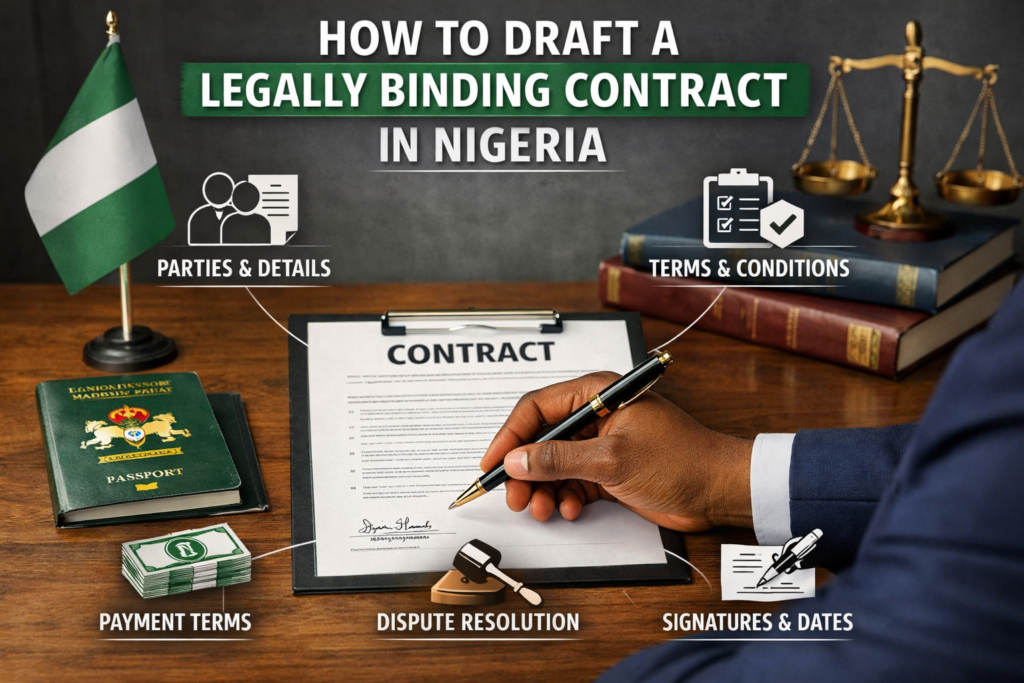
The Contract was “fine” until the money disappeared: How to Draft a Legally Binding Contract that actually protects you in Nigeria
The first thing she noticed was the silence.
Not the peaceful kind. The dangerous kind.
Three months earlier, the tailor shop had been buzzing — sewing machines rattling, generators coughing in the background, customers drifting in and out with wedding fabrics wrapped under their arms. But now the chairs were empty. Her supplier had disappeared with nearly half a million-naira worth of materials, and every phone call ended the same way:
“Madam, we didn’t agree like that.”
She kept repeating one sentence like it could rewind time.
“But we had an agreement.”
The problem was that the agreement lived in WhatsApp voice notes and vague promises. No written contract, no signatures and no clear payment terms. Just trust stretched too thin.
And here’s the uncomfortable truth nobody tells you early enough in business or even personal transactions in Nigeria:
A handshake is warm.
A contract is warmer.
Because when things go wrong — and sometimes they do — memory becomes slippery. People suddenly remember conversations differently. Deadlines become “suggestions.” Payments become “misunderstandings.”
That’s usually the moment people start searching frantically:
“How do I draft a legally binding contract in Nigeria?”
Not before the problem. After the damage.
I know because I’ve made that mistake too. Years ago, I once worked on a small project without insisting on a proper agreement because I didn’t want to “look difficult.” I thought professionalism meant flexibility.
It cost me weeks of stress and one painful lesson:
Clarity is kinder than assumption.
Why Contracts Feel Intimidating (Even to Smart People)
Most people hear the word contract and immediately picture:
- intimidating legal jargon,
- pages thick enough to stop a bullet,
- and lawyers charging fees that make your chest tighten.
So they avoid it.
Instead, they download random templates online. Or worse, they scribble vague terms on paper and hope for the best.
The trouble is that Nigerian law doesn’t care about what you meant. It cares about what you can prove.
And that changes everything.
The Moment the Whole Thing Finally Clicks
A good contract is not about sounding smart.
That’s the part many people get wrong.
A contract is simply a written record of:
- who is doing what,
- when they’ll do it,
- how much is involved,
- and what happens if someone fails to keep their word.
That’s it.
Once you stop trying to sound like a courtroom drama and start aiming for clarity, drafting a contract becomes far less frightening.
In fact, the best contracts are often the easiest to read.
So, What Makes a Contract Legally Binding in Nigeria?
Under Nigerian law, a contract generally becomes enforceable when a few basic conditions are met.
Simple things. Human things.
1. Somebody Must Make an Offer — And Someone Must Accept It
This sounds obvious until you see how many disputes begin with blurry communication.
If a graphic designer says:
“I’ll design your company logo for ₦150,000.”
And the client replies:
“Agreed.”
That’s the foundation of a contract already forming.
But this is where people sabotage themselves: they leave details hanging in the air.
How many revisions?
What’s the deadline?
When is payment due?
Tiny omissions become giant arguments later.
Write everything down.
Not because you expect war.
Because you respect clarity.
2. Money (Or Something Valuable) Must Exchange Hands
Lawyers call this consideration, but honestly, normal humans call it value.
One party gives something.
The other party gives something back.
It could be:
- money,
- services,
- goods,
- property,
- or even a promise to perform a task.
No exchange? The contract starts wobbling legally.
3. Everybody Must Actually Understand What They’re Signing
This sounds funny until you realise how often people sign documents they never read.
Or worse, documents they don’t understand.
A contract signed under:
- fraud,
- pressure,
- threats,
- or serious misunderstanding
can collapse in court. And yes, courts in Nigeria do examine these things closely.
4. The Part Most People Skip — And Regret Later
Now we get to the practical side.
The actual drafting.
This is where many contracts quietly fail.
Start With the Names. Real Names.
Not:
“Chairman.”
Not:
“My brother.”
Use full legal identities which should include:
- Full names
- Addresses
- Phone numbers
- Business registration details (if applicable)
Be mindful of the tiny details. It’s of massive importance.
You cannot effectively enforce an agreement against a ghost.
5. Be Painfully Clear About Responsibilities
This is not the place for poetry.
Bad contract language:
“The work will be done promptly.”
What does “promptly” even mean?
Better:
“The contractor shall deliver the completed work on or before 15 October 2026.”
Specific beats clever every single time.
6. Always Include Payment Terms
This is where emotions usually explode.
State:
- exact amount,
- payment method,
- due dates,
- installment structure,
- penalties for delay.
Awkward conversation now. Peace later.
7. Don’t Forget the Exit Door
One of the smartest clauses you can add is a termination clause.
Because sometimes things genuinely fall apart.
Your contract should explain:
- how either party can end the agreement,
- required notice periods,
- and what happens to money or unfinished work afterwards.
Without this, endings become chaotic and expensive.
8. A Quick Reality Check About Online Templates
Some templates online are useful.
Some are disasters wearing neckties.
Be careful copying contracts from foreign websites without adapting them to Nigerian law. What works in Texas may completely fail in Lagos.
And please — this is important — do not blindly recycle contracts you barely understand.
That’s like borrowing someone else’s prescription glasses and hoping your vision improves.
When You Should Absolutely Speak to a Lawyer
Not every agreement needs a lawyer hovering dramatically over a mahogany desk.
But some situations do.
Especially when:
- large money is involved,
- property is involved,
- intellectual property rights matter,
- partnerships are forming,
- or the risk feels significant.
Sometimes a short legal review can save years of regret.
The Strange Thing About Contracts
People think contracts destroy trust.
I think the opposite is true.
Good contracts protect relationships because everybody already knows the rules before emotions enter the room.
No guessing.
No “I thought you meant…”
No late-night arguments over screenshots.
Just clarity.
And honestly? Clarity is one of the most underrated forms of respect.
Final Thoughts
If you remember nothing else from this article, remember this:
A contract is not about preparing for betrayal.
It is about protecting peace before confusion arrives.
That supplier who disappeared?
That unpaid freelancer?
That business partner who suddenly changed the story?
Most of those disasters begin the same way:
“We didn’t think we needed a proper agreement.”
Until they did.