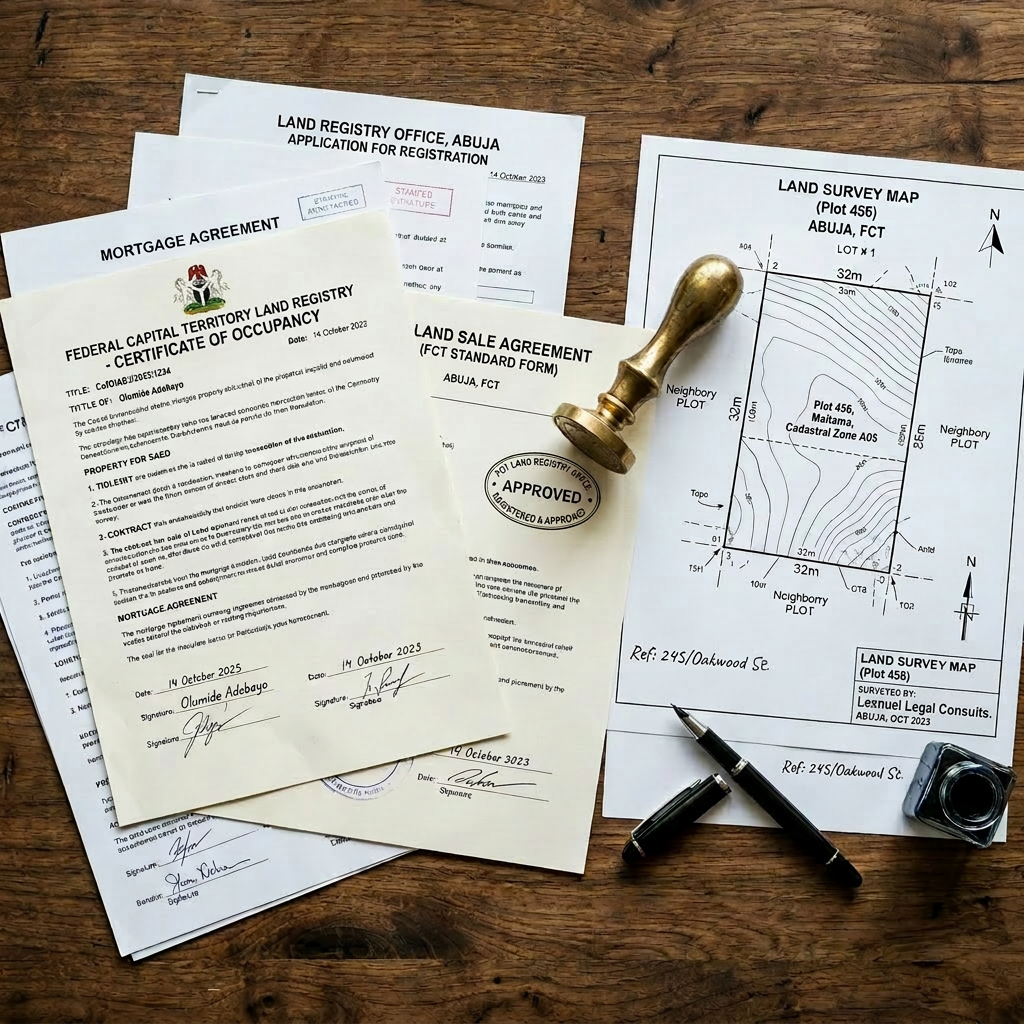
Real Estate Investment in Nigeria: Dos and Don’ts
The Cautionary Tale Nobody Puts in the Brochure
Let me tell you about Emeka.
Emeka is a smart guy, an engineer. He works in Port Harcourt, sends money home, and saves diligently with hopes of venturing into Real Estate Investment. In 2019, a childhood friend tells him about a “hot deal” — a plot of land in a fast-developing corridor off the Lekki-Epe Expressway. The price? ₦7.5 million. The paperwork? “Everything is complete,” the friend says, grinning. “The family even has a C of O.”
Emeka pays. Gets a receipt. Takes photos for Instagram. Dreams of a duplex.
By 2021, a different family — a larger family — shows up on the land with machetes, an Abuja court order, and a very different story about who actually owns that soil. Turns out, the person who sold to Emeka was one of eleven children in a compound family dispute that had been dragging through the Epe Magistrate Court for six years. Nobody told Emeka. Because nobody asked.
The ₦4.5 million? Gone. The land? Gone. The friend? Let’s just say he’s no longer reachable.
I’ve seen this go wrong a hundred times in Lagos, Abuja, Enugu, Ibadan, and Port Harcourt. The names change. The amount changes. The heartbreak does not.
Here’s the truth: Real Estate investment in Nigeria is genuinely one of the most powerful wealth-building tools available to you. Land appreciates. Rental yields are strong. The housing deficit runs into millions of units. The opportunity is real. But this market does not forgive ignorance. And it does not convey sentiment.
So let’s do this properly.
Why Nigeria’s Real Estate Market Is Still Worth Your Money
Before we get into the legal scaffolding, understand what you’re walking into.
Nigeria has a housing deficit of approximately 28 million units. Urbanisation is relentless — Lagos alone absorbs hundreds of thousands of new residents every year. Abuja is expanding outward from Maitama and Asokoro into Kuje, Bwari, and beyond, with the FCDA consistently opening new districts. Prices in emerging corridors have historically tripled within a decade.
Real Estate Investment Nigeria — as a theme — is not hype. It is demographics, infrastructure spend, and a swelling middle class all pointing in the same direction: up.
But you need the right documents.
The Four Documents That Actually Protect You
1. Certificate of Occupancy (C of O)
The C of O is the gold standard. Under the Land Use Act of 1978 still the governing law, all land in Nigeria is vested in the Governor of each state. A C of O is the Governor’s formal grant of a statutory right of occupancy to an individual or entity for a defined term (typically 99 years).
- A C of O gives you the highest form of title recognition in Nigeria.
- It is registrable at the state land registry at Alausa in Lagos (Lands Bureau, Block 16, the Secretariat) or the FCDA Land Administration Department in Abuja.
- A legitimate C of O has a serial number, a survey plan attached, and can be verified at the issuing registry.
- Never accept a C of O without physically verifying it at the relevant registry. Counterfeits exist. They are convincing. Verification costs almost nothing. Ignorance costs everything.
2. Governor’s Consent
Here’s where people trip. When you buy land that already has a C of O, meaning it was previously allocated to someone. The law requires the Governor’s express consent to that transfer before it is valid.
No Governor’s Consent = the transaction is legally incomplete, regardless of how much you paid.
This is not a technicality. Section 22 of the Land Use Act is explicit. A transaction without the Governor’s Consent can be voided. Courts have done it. I’ve watched it happen in a Tribunal in Ikoyi on a Tuesday afternoon.
- Governor’s Consent is obtained after execution of a Deed of Assignment (see below).
- It is processed through the state Lands Bureau — Lagos at Alausa, Abuja, through the FCDA.
- Expect processing timelines of several months in Lagos; Abuja can be somewhat faster depending on the district.
- Fees are payable: consent fees, stamp duties, registration fees. Budget for them upfront.
3. Deed of Assignment
This is your sale contract, the formal instrument by which a seller transfers their interest in land to you. A properly drafted Deed of Assignment must contain:
- Full particulars of both parties (with valid ID verification)
- A precise description of the property, referencing the survey plan
- The purchase price (or consideration)
- Covenants and warranties from the seller
- Evidence of the root of title being assigned
Without this document, properly executed and stamped, you have nothing that a court will take seriously.
A handshake won’t do. WhatsApp voice notes won’t do. Even a receipt won’t do — not alone. You need a Deed. Drafted by a lawyer. Signed by both parties. Stamped at the Nigerian Revenue Service or the State Board of Internal Revenue.
4. Survey Plan
Linked to everything above but often treated as an afterthought. A survey plan defines the exact coordinates of what you are buying. It must be:
- Prepared by a registered surveyor (check the Surveyors Registration Council of Nigeria — SURCON)
- Free from government acquisition (the surveyor must confirm this with the relevant state Ministry)
- Filed with the state surveyor-general’s office
Pro tip: In Lagos, always check that the survey plan is not within a government-acquired or committed area. A significant portion of Lagos land has been committed to government projects at one point or another. Your surveyor must confirm the land is “free from government acquisition” in writing.
The Omo-onile Problem (And How to Handle It)
Let’s talk about the elephant in every Lagos transaction.
Omo-onile — literally “children of the land owner” — refers to local community members who assert customary rights over land, sometimes aggressively, sometimes with a genuine legal basis, often with neither. They collect “development levies,” block site access, and occasionally demolish structures. They are a real operational risk in Lagos and parts of Ogun State.
Here’s how you manage it:
- Buy titled land. Omo-onile activity is most aggressive on land that lacks formal documentation. A properly titled parcel with a C of O and registered Deed of Assignment dramatically reduces your exposure.
- Engage the community formally. Before development, have your lawyer facilitate a meeting. Document it. Payments made should be receipted and reflected in a Community Consent letter, not just cash-to-hand.
- Involve your lawyer before, not after. The worst time to call me is after you’ve broken ground and men with cutlasses are on your site. The best time is before you sign anything.
Family Land: The Hidden Trap
Family land — also called communal or compound land — is land held collectively by a family under customary law. It is extremely common in Lagos, Ogun, Oyo, Ondo, and the South-East.
The core problem: Any one family member can appear to sell you the land. They may even have partial authority. But under customary law, the entire family’s consent may be required. And the family — trust me — will not always agree.
Before buying family land:
- Insist on meeting the Head of Family — the recognised family representative.
- Obtain a Family Resolution — a formal document signed by principal family members consenting to the sale.
- Have your lawyer conduct a root of title search at the land registry and through customary inquiries.
- Verify there are no pending family disputes in court. A search at the relevant State High Court registry will reveal pending litigation.
Family land is not automatically bad land. Some of the most affordable and well-located parcels are family land. But you must do the work every time.
A Step-by-Step Buying Process for Beginners Interested in Real Estate
Whether you’re eyeing a plot in Sangotedo, a commercial property in Wuse II, or a distress sale in Trans-Amadi, this is the process:
Step 1 — Engage a Property Lawyer First, not after. First. Before you pay a single kobo in “commitment fees.” Your lawyer’s job is to examine the title, raise the red flags, and structure the transaction correctly.
Step 2 — Conduct a Land Search. Your lawyer searches the title at the relevant land registry — Alausa (Lagos) or the FCDA/Abuja Geographic Information Systems (AGIS) department. This confirms ownership, encumbrances, and any prior government acquisition.
Step 3 — Review the Title Documents. Examine the full chain of title — how the land was originally allocated, who it passed through, and how it arrived at the current seller. Every link in that chain must hold.
Step 4 — Negotiate and Execute a Contract of Sale. A preliminary Contract of Sale (not the final Deed) locks in the terms while perfection is completed. A deposit, typically 10–30%, is paid at this stage.
Step 5 — Execute and Stamp the Deed of Assignment Draft, execute, and stamp the Deed. Stamp duties must be paid within the prescribed period to avoid penalties.
Step 6 — Obtain Governor’s Consent. Apply through the state Lands Bureau for consent to the assignment. Prepare for the fees and the timeline.
Step 7 — Register the Title. Register the consented Deed at the land registry. This is what closes the loop. Your name in that registry is your armour.
Choosing Your Entry Point: Where to Invest in 2025–2026
Lagos remains the most active market. Corridors showing sustained appreciation include:
- Lekki Phase 2 and beyond — still growing, with infrastructure catching up.
- Ibeju-Lekki — the Dangote Refinery and Lekki Free Zone are genuine long-term catalysts. High risk, high reward.
- Ajah to Sangotedo — mid-market sweet spot with strong rental demand.
Abuja is the market for the patient investor. Land values are anchored by government presence and embassy clusters. Emerging areas under FCDA expansion — Guzape, Katampe, Jabi axis — offer better entry prices than mature districts like Maitama or Asokoro, with solid upside.
Secondary cities — Ibadan, Enugu, and Port Harcourt are underappreciated. Ibadan, in particular, has strong infrastructure investment ongoing, and land prices remain significantly below Lagos equivalents.
The Three Mistakes That Drain First-Time Investors
Mistake 1: Paying before searching. The seller always seems trustworthy. The photos always look fine. Pay your lawyer before you pay the seller.
Mistake 2: Buying without Governor’s Consent “to save time.” You are not saving time. You are building on a foundation of legal incompleteness. Consent is not optional.
Mistake 3: Holding undocumented land “to perfect later.” Later becomes never. Sellers die. Families fragment. Documents disappear. The longer you wait to perfect your title, the harder and more expensive it becomes. Perfect immediately.
Final Word
Real estate Investment in Nigeria is not a lottery. It is a system — complex, occasionally ruthless, but absolutely navigable with the right knowledge and the right lawyer beside you.
Emeka’s story didn’t have to end the way it did. He had the money. He had the desire. What he lacked was the process.
You now have the process.
Go buy land. The right way.
Have questions about a specific property transaction or title issue? Drop them in the comments. I read everyone.