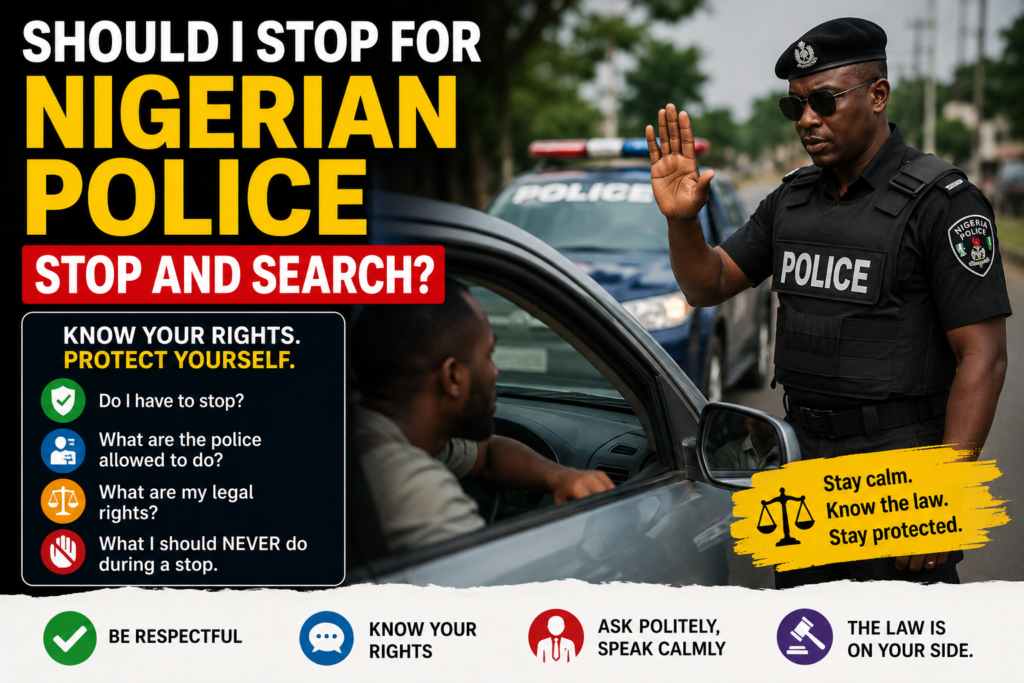
Nigerian Police Stop and Search: Know Your Exact Legal Rights
You are driving home.
Or walking down the street.
Suddenly, a police officer signals you to stop.
Your heart starts racing.
What happens next?
Can they search your phone or your car?
Can they force you to answer questions?
Are you going to be arrested for refusing to pay a bribe?
Many Nigerians are unsure about their rights during a police stop-and-search.
That uncertainty can lead to fear, confusion, and sometimes abuse.
The good news is that the law gives you rights.
Knowing those rights can help you stay calm, protect yourself, and avoid unnecessary trouble.
This guide explains exactly what to do if Nigerian police stop you and what your legal rights are during a stop-and-search.
Can Nigerian Police Stop You?
Yes.
The police can stop individuals and vehicles in certain situations.
This may happen during:
- Routine patrols
- Security operations
- Roadblocks
- Criminal investigations
- Traffic enforcement
Being stopped does not mean you have committed a crime.
Sometimes officers are conducting routine checks.
Stay Calm First
Your first reaction matters.
Do not:
- Argue aggressively
- Shout at officers
- Resist physically
- Make sudden movements
Instead:
- Remain polite
- Keep your hands visible
- Speak calmly
- Follow lawful instructions
Being respectful does not mean giving up your rights. It simply helps keep the situation under control.
What Are Your Rights During a Police Stop?
You Have the Right to Know Why You Were Stopped
A police officer should be able to explain why you are being stopped.
You can politely ask:
“Officer, may I know why I have been stopped?”
This is a reasonable question.
It is not disrespectful.
Understanding the reason helps you know what is happening.
You Have the Right to Be Treated With Respect
Every Nigerian has the right to dignity.
This means police officers should not:
- Assault you
- Humiliate you
- Use abusive language
- Threaten you unnecessarily
Respect should go both ways.
You should remain respectful as well.
You Have the Right to Remain Silent
This surprises many people.
You do not have to answer questions that may incriminate you.
You may politely say:
“I would prefer to speak in the presence of my lawyer.”
You should provide basic identifying information when legally required.
However, you are not required to confess to a crime or make statements against yourself.
Can the Police Search You?
Yes, under certain circumstances.
Police officers may conduct a search if they reasonably suspect:
- You possess illegal items.
- You are involved in criminal activity.
- You may be carrying a weapon.
However, the search should not be abusive or excessive.
Can Nigerian Police Search Your Phone?
This is one of the most common questions Nigerians ask.
The short answer is:
Not automatically.
Your phone contains private information.
In many situations, officers should have a lawful basis for demanding access to your phone.
What You Should Do
Remain calm.
Ask politely:
“Officer, under what authority are you requesting access to my phone?”
Do not become confrontational.
Do not physically resist.
If the situation escalates, comply peacefully and document what happened later.
Never attempt to destroy evidence or obstruct an investigation.
Can Police Search Your Vehicle?
Yes.
Police may inspect a vehicle during lawful operations or where there is reasonable suspicion.
If your vehicle is searched:
- Stay calm.
- Observe the process.
- Avoid interfering.
- Take note of the officers involved.
Do not physically obstruct a search.
That may create additional problems.
Do You Have to Pay Money at a Checkpoint?
No.
There is no law requiring motorists or pedestrians to pay money at checkpoints.
If an officer requests money without a lawful basis:
- Remain polite.
- Do not argue aggressively.
- Do not offer a bribe.
- Request clarification if necessary.
Offering a bribe can also be a criminal offence.
What If Police Want to Arrest You?
An arrest does not automatically mean guilt.
If you are arrested:
You Have the Right to Know Why
Ask:
“Officer, why am I being arrested?”
You should be informed of the reason for your arrest.
You Have the Right to Contact a Lawyer
One of your most important rights is access to legal representation.
Request to contact your lawyer as soon as possible.
You Have the Right to Contact Family
You may notify a family member or trusted person about your situation.
You Have the Right to Remain Silent
You are not required to make a statement immediately.
Consider speaking with a lawyer first.
What Should You Never Do During a Police Stop?
Even when you believe an officer is wrong, avoid these mistakes:
Do Not Resist Arrest
Physical resistance can worsen the situation.
Do Not Fight Officers
Disputes should be handled through legal channels.
Do Not Insult Officers
Insults can escalate tension unnecessarily.
Do Not Attempt to Bribe Anyone
Bribery creates legal risks for everyone involved.
Do Not Flee
Running away may create suspicion and increase danger.
What Information Should You Record?
If you believe your rights were violated, try to record details such as:
- Officer’s name
- Badge number
- Police station
- Patrol vehicle details
- Location
- Date and time
- Witness information
Documenting details can be helpful if a complaint becomes necessary.
How to File a Complaint Against Police Misconduct
If you experience misconduct, you may consider reporting it through:
- The Nigeria Police Force complaint channels
- Human rights organizations
- Legal practitioners
- Relevant oversight bodies
Provide as much information as possible because facts and evidence matter.
A Simple Stop-and-Search Checklist
If Nigerian police stop you:
If Nigerian police stop you:
Stay calm
Be respectful
Ask why you were stopped
Keep your hands visible
Know your right to remain silent
Request a lawyer if necessary
Document important details
Do not resist or fight
Never offer a bribe
Do not make false statements
Just Remember
Most encounters with police officers end without problems.
The key is knowing your rights before you need them.
Stay calm and respectful.
Know what the law allows and what the law does not allow.
The more informed you are, the better equipped you will be to protect yourself during a stop and search because confidence comes from knowledge, not confrontation.