What Happens If You Die Without a Will in Nigeria?
Nobody likes to think about death. But ignoring it won’t make it go away.
If you die without a will in Nigeria, the law decides what happens to everything you own. Not your family. Not your friends. The government.
This is called dying “intestate.” And it happens more often than you think.
Here’s the hard truth: your savings, your car, your house, even your phone- all of it gets distributed according to rules you had no say in.
Let’s break down what actually happens and, more importantly, how you can prevent the headache for the people you leave behind.
What Does “Dying Without a Will” Mean in Nigeria?
When someone passes away without a valid will, lawyers call it “intestate succession.”
It simply means there are no written instructions for sharing your property. Those instructions are usually called “A Will”.
And in Nigeria, this creates a massive problem. Because without clear guidance, family members often fight over who gets what.
The worst part? The person you trusted most- your spouse, your eldest child, your best friend-has zero legal power to handle your affairs until a court says otherwise.
Nigeria Has Three Different Inheritance Systems
Here’s where it gets complicated.
Nigeria doesn’t have one single set of inheritance rules. It has three separate systems that can apply depending on your background. It all depends on your location.
1. Statutory Law (Administration of Estates Law)
This applies mainly to Christians and people married under the Marriage Act.
The Administration of Estates Law of Lagos State (2015) governs how assets are shared when there’s no will.
Under this system:
Spouse and children inherit first
Parents and siblings come next if there’s no spouse or kids
Extended relatives inherit if immediate family isn’t around
2. Customary Law
This varies by tribe and ethnic group.
Igbo custom traditionally favours male children over female children
Yoruba custom has its own rules
Hausa/Fulani custom follows different traditions
Important note: Courts have ruled that customary laws that discriminate against women may violate the Nigerian Constitution.
3. Islamic Law (Sharia)
For Muslims, inheritance follows fixed Quranic shares.
This applies mainly in northern Nigeria and operates independently of the other systems.
The catch? These systems don’t always exist separately. They can overlap.
For example: you might have a house in Lagos (statutory law), land in your village (customary law), and be Muslim (Islamic law).
Without a will, your estate gets pulled in different directions. And your family pays the price.
The First Thing That Must Happen: Letter of Administration
Here’s something most people don’t know.
Nobody automatically inherits authority over your estate. Not your husband. Not your wife. Not your eldest son.
Before anyone can touch your money, sell your property, or distribute your belongings, the court must appoint someone to manage your estate.
This happens through a Letter of Administration.
What Is a Letter of Administration?
It’s a legal document issued by the Probate Registry that grants a specific person the power to handle your affairs.
Without this document, no one has the legal right to:
Access your bank accounts
Sell your property
Transfer your shares
Distribute your belongings
Until the Letter of Administration is obtained, your estate legally belongs to the Chief Judge of your state.
Who Can Apply for a Letter of Administration?
The law sets a clear order of priority.
Surviving spouse – first in line
Children – or grandchildren of a child who died before you
Parents – your father or mother
Siblings – brothers and sisters of full blood
Half-siblings – brothers and sisters of half-blood
Grandparents – your grandfather or grandmother
Uncles and aunts – of full blood, or their children
Creditors – people you owe money to (in limited cases)
Administrator General – if nobody else qualifies
Real talk: This order doesn’t always prevent conflict. Multiple family members often fight over who should be the administrator.
How to Get a Letter of Administration (Step by Step)
If you find yourself in this situation, here’s what to do.
Step 1: Confirm there’s no valid will
Check everywhere. If a will exists, you don’t need a Letter of Administration.
Step 2: Determine who’s eligible to apply
Check the priority order above. The person highest on the list should apply.
Step 3: Visit the Probate Registry
Go to the Probate Registry in the state where the deceased lived.
Step 4: Get and fill in the required forms
You’ll need:
Application for grant of Letter of Administration
Oath of Administration
Administration Bond
Declaration as to Next of Kin
Inventory of assets
Schedule of debts and funeral expenses
Sureties’ Application Form
Step 5: Gather supporting documents
Death certificate
Passport photos of the deceased
Passport photos of all proposed administrators and sureties
Step 6: Submit and pay the fees
The court will review your application. If everything checks out, they’ll issue the Letter of Administration.
The Life Hack: Write a Will (It’s Easier Than You Think)
Here’s the truth: everything above is avoidable.
You can bypass all this court drama by writing a simple will.
What Makes a Will Valid in Nigeria?
Must be in writing
You must be at least 18 years old
You must be of sound mind
At least two witnesses must sign it
What Happens If You Have a Will?
Your appointed executor (not the court) handles your affairs.
Then your assets go exactly where you want them to go.
This prevents your family from fighting over who’s in charge.
It’s that simple.
What Most Nigerians Get Wrong About Wills
Myth #1: “Wills are only for rich people.”
False. Your savings account, car, and personal belongings are worth protecting.
Myth #2: “Writing a will means I’m going to die soon.”
Nonsense. It means you’re being responsible.
Myth #3: “My family will automatically know what to do.”
They won’t. And they’ll probably fight about it.
Myth #4: “I’m too young to need a will.”
If you own anything of value, even a bank account, you need one.
What Happens to Your Assets Under Statutory Law?
Here’s the breakdown for young, single Nigerians:
If you have a spouse and children: They inherit everything
If you have no spouse or children: Your parents inherit
If your parents are dead: Your siblings inherit
If no immediate family exists: Extended relatives inherit
But remember: If you’re governed by customary or Islamic law, the rules change completely.
The same person’s assets could be divided three entirely different ways depending on their background.
The Cost of Not Planning
Let me be blunt.
When you die without a will in Nigeria:
Your family will go to court – costing time and money
Your assets will be frozen – nobody can access them
Your business could collapse – no one has authority to make decisions
Your loved ones will fight – over things you never wanted them to fight about
The government decides – not you, not your family
That’s not how you want to be remembered.
Quick Action Steps (Do This Today)
List everything you own – bank accounts, property, investments, vehicles
Decide who gets what – be specific
Choose an executor – someone you trust to carry out your wishes
Visit a lawyer – to draft a valid will (it’s affordable)
Sign it with two witnesses – and keep it somewhere safe
Tell your family where to find it – don’t leave them guessing
Final Thought
You have the power to change that.
Not your spouse, children, nor parents.
The law, written decades ago, will determine who gets everything you worked for.
You have the power to change that.
A simple will costs less than a dinner out. But it saves your family from years of court battles, legal fees, and broken relationships.
Don’t leave your loved ones with a mess to clean up.
Write your will. Protect your family. Control your legacy.
Wondered if your CV might be why you haven’t been getting responses to your job applications?
You spent hours on your CV. You hit send. Then… nothing.
Here’s the uncomfortable truth. A human may never even see that CV. A robot read it first, and it said no.
That robot is called an ATS, short for Applicant Tracking System. Almost every remote job now runs your CV through one before a real person looks at it. If your CV isn’t built for that, you’re invisible no matter how good you are.
Good news: this isn’t a mystery. Once you know how these systems think, you can write a CV that passes AI filters every single time.
Let’s fix this together.
What Is an ATS and Why Should You Care?
Think of an ATS like airport security for your job application.
It scans your CV, looks for keywords, checks your formatting, and decides if you’re worth a second look. No stamp of approval, no interview.
This matters even more for remote international jobs. Companies hiring across borders get flooded with applications. They rely on AI filters more than local companies do to manage volume.
So your CV isn’t competing with 20 people anymore. It’s competing with 2,000. The ATS is the bouncer deciding who gets in.
The Biggest Mistake People Make With Their CV
Most people design their CVs to look pretty first and to be readable by AI second.
That’s backwards.
Fancy templates with columns, graphics, and creative layouts often confuse the software. It can’t read text trapped in a text box, and it skips tables. Then, it ignores headers stuffed inside images.
Your beautiful, designer CV might be landing in the trash folder, unread, simply because a machine couldn’t parse it.
How to Format Your CV So the AI Actually Reads It
Keep this part boring on purpose. Boring works.
Use a single-column layout, not two or three
Stick to standard fonts like Arial, Calibri, or Georgia
Avoid text boxes, headers, footers, and tables
Save your file as a .docx or a text-based PDF, never an image-based PDF
Use simple section titles like “Work Experience,” not “My Journey”
That last point matters more than people think. ATS software is trained to recognise common labels. If you get creative with your titles, it may skip the section entirely.
Quick Life Hack: The Copy-Paste Test
Here’s a fast way to check if your CV is ATS-friendly.
Open your CV file. Select all the text. Copy it. Paste it into a plain notepad or text file.
If everything shows up in the right order and nothing is missing, you pass. If the text is jumbled or sections are missing, an ATS will struggle too.
This takes two minutes and saves you from silent rejections.
Keyword Matching: The Real Secret to Beating AI Filters
This is where most job seekers lose the game without knowing it.
ATS software scans your CV for keywords that match the job description. No match, no interview, even if you’re perfect for the role.
How to Find the Right Keywords
Open the job posting you want to apply for
Highlight every skill, tool, and qualification they mention
Note repeated phrases, like “cross-functional teams” or “remote collaboration”
Use those exact phrases in your CV, not synonyms
If the job says “project management,” don’t write “team coordination.” Say “project management.” The AI is matching text, not reading your mind.
The Mirror Trick
Here’s a simple hack that works fast.
Keep the job description open next to your CV while you edit. Literally mirror their language back at them, section by section.
If they ask for “stakeholder communication,” use that exact term in your experience bullet points. This single habit can double your callback rate for remote roles.
Writing for Remote and International Roles Specifically
Remote job CVs need a few extra touches that in-office CVs don’t.
Companies hiring remotely want proof you can work independently across time zones. Say that clearly; don’t just imply it.
Mention specific tools you’ve used: Slack, Zoom, Asana, Notion
Include time zones you’ve worked across, if relevant
Add a line about async communication or self-management
Skip your full home address; a city and country are enough for international applications
Recruiters searching “remote job resume tips” are usually looking for exactly this. Global hiring teams want candidates who don’t need hand-holding.
Should You List Your Location Differently for Global Jobs?
Yes, and this trips people up constantly.
Skip your street address completely. List your city and country only, like “Lagos, Nigeria” or “Berlin, Germany.”
This protects your privacy. It also signals to the recruiter and the ATS that you’re already thinking globally, not locally.
A Simple Checklist Before You Hit Submit
Run through this list every time before you apply:
File saved as .docx or text-based PDF
Single column, no tables or text boxes
Standard section headers used
Keywords from the job post mirrored in your bullet points
Job titles match industry standard terms
Remote-specific skills clearly listed
Contact info includes city, country, email, and LinkedIn
Five minutes with this checklist can be the difference between a reply and silence.
A Word on Fairness and How AI Screening Actually Works
It’s worth knowing that using an ATS to screen candidates isn’t something companies are required to disclose in most cases.
Some countries are starting to introduce rules around automated hiring decisions, especially in the EU. But enforcement varies a lot, and most job seekers won’t ever know exactly how a company’s filter is set up.
The safest move is not to fight the system. Write a CV so clean and keyword-matched that it sails through, no matter which software is on the other end.
Finally
Getting your CV past AI filters isn’t about tricking anyone. It’s about speaking the same language the software understands, then letting your real experience shine once a human sees it.
Keep it simple. Mirror the job posting. Test your formatting. Do this consistently, and you’ll start getting more replies from remote and international employers.
Can You Sue Someone for Breaking a Promise to Marry? Here’s What the Law Really Says
You spent years building a relationship.
Your families knew each other. Wedding plans had started. Money had been spent. Then, without warning, your fiancé or fiancée called everything off.
Now you’re left asking one question:
Can I sue this person for breaking their promise to marry me?
The short answer is yes, but not always.
The law does not force anyone to marry against their will. Marriage is a voluntary union. However, where someone makes a genuine promise to marry, causes the other person to rely on that promise, and later walks away without lawful justification, the law may allow the injured party to seek compensation.
The answer depends on the facts, the evidence, and the country whose laws apply.
Let’s unpack what the law really says.
Is a Promise to Marry Legally Binding?
Many people assume that an engagement is merely a romantic commitment with no legal consequences.
That isn’t entirely true.
Although an engagement is not the same as marriage, it can create legal obligations under certain circumstances.
The courts generally recognise that a promise to marry is more than casual dating when there is clear evidence that both parties genuinely intended to marry each other.
The law does not punish someone simply because they changed their mind.
Instead, it examines questions such as:
Was there actually a promise?
Was the promise serious?
Did the other person rely on that promise?
Did the breakup cause measurable financial or emotional loss?
Those questions often determine whether a lawsuit can succeed.
The Law Doesn’t Force Marriage
This is perhaps the most important point.
No court can order someone to marry another person.
Marriage requires free and voluntary consent.
Even if someone clearly promised to marry you, the court cannot compel the wedding to take place.
Instead, where appropriate, the court may award financial compensation for losses resulting from the broken promise.
What Is a Breach of Promise to Marry?
A breach of promise to marry occurs when:
one person makes a genuine promise to marry another,
the other person accepts that promise,
wedding plans progress or significant reliance occurs,
and one party later refuses to marry without lawful justification.
This type of claim has existed in many legal systems for centuries, although several countries have abolished or restricted such actions.
Ezeanah v. Atta (2004) 11 NWLR (Pt. 884) 464: The Supreme Court (per Niki Tobi, JSC) ruled that a mere romantic relationship or “whispering of sweet nothings” is not enough to establish a promise. The agreement must be concrete and leave no one in doubt. However, the court held that a written agreement is not required; a promise to marry can be inferred from the parties’ conduct.
What Does Nigerian Law Say?
In Nigeria, a breach of promise to marry can still give rise to a civil action.
However, winning such a case is far from automatic.
The person bringing the lawsuit must convince the court that:
there was a genuine promise to marry;
both parties intended marriage;
the defendant broke that promise;
The claimant suffered actual damage because of the broken promise.
Courts examine each case individually.
No two cases are exactly alike.
What Evidence Can Prove a Promise to Marry?
This is where many cases succeed—or fail.
Simply saying,
“He promised to marry me,”
is rarely enough.
Strong evidence may include:
Engagement ceremonies
Traditional introductions or engagement ceremonies often strengthen a claim that marriage was genuinely intended.
Wedding preparations
Evidence may include:
venue bookings
bridal payments
wedding invitations
deposits paid to vendors
receipts
photographs
These documents demonstrate that the relationship had moved beyond casual dating.
Messages and Emails
Text messages can become powerful evidence.
For example:
“I can’t wait for us to get married next December.”
or
“Let’s begin paying for our wedding.”
Such conversations may support the existence of a promise.
Witnesses
Family members.
Friends.
Religious leaders.
Anyone who witnessed the engagement or discussions about marriage may provide useful testimony.
Can You Claim Emotional Distress?
Many people suffer serious emotional pain after a broken engagement. The law recognizes that heartbreak can have significant consequences.
However, courts generally require more than sadness or disappointment. They look for evidence of actual harm, such as:
financial losses
humiliation
reputational damage
psychological injury supported by evidence
The stronger the proof, the stronger the claim.
Can You Recover Money Spent on the Wedding?
Possibly.
Suppose you paid for:
wedding decorations
catering
photography
honeymoon reservations
wedding attire
invitation cards
If those expenses became wasted solely because the other party unjustifiably backed out, the court may consider awarding damages. Every expense should be supported with receipts or other evidence.
What If Someone Cheats Before the Wedding?
Suppose your fiancé develops another relationship shortly before the wedding.
Does that automatically mean you can sue? Not necessarily.
The issue is not simply infidelity.
The court asks whether the conduct amounted to an unjustified breach of the promise to marry.
Each situation depends on its unique facts.
What If There Was No Formal Engagement?
A ring is not always necessary.
Some couples never hold formal engagement ceremonies.
Others never exchange rings.
That alone does not destroy a legal claim.
What matters is whether there is convincing evidence that both parties genuinely agreed to marry.
Can Parents Sue?
Usually, no.
The right belongs to the person whose promise was broken.
Parents generally cannot sue merely because they spent money or suffered embarrassment, unless the law provides another independent basis for their claim.
When a Court May Refuse Your Claim
Not every broken engagement leads to compensation.
A court may reject the claim where:
there was never a genuine promise;
both parties mutually agreed to end the relationship;
the claimant cannot produce evidence;
the defendant had lawful reasons for ending the engagement;
The alleged promise was vague or uncertain.
The burden of proof rests on the person bringing the lawsuit.
Practical Steps to Take Before Filing a Lawsuit
If you believe someone unlawfully broke a promise to marry, avoid acting out of anger.
Instead:
1. Preserve every piece of evidence.
Keep messages.
Emails.
Receipts.
Photographs.
Voice recordings, where lawfully obtained.
2. Write down the timeline.
Record important dates while events remain fresh in your memory.
3. Calculate your financial losses.
List every expense connected with the planned marriage.
Attach receipts wherever possible.
4. Speak to a lawyer early.
A lawyer can assess whether your evidence supports a viable legal claim before you spend money on litigation.
5. Consider settlement.
Court proceedings can be lengthy and emotionally draining.
Sometimes a negotiated settlement protects everyone’s interests better than a courtroom battle.
Frequently Asked Questions
Can someone be arrested for breaking a promise to marry?
Generally, no.
Breaking a promise to marry is usually a civil matter rather than a criminal offence. However, if the circumstances involve fraud, obtaining money by deception, or another criminal act, separate legal consequences may arise.
Is an engagement ring legally recoverable?
It depends on the circumstances and the applicable law. Courts may consider whether the ring was an unconditional gift or one given in contemplation of marriage.
Is there a time limit for bringing a claim?
Yes. Civil claims are generally subject to limitation periods, which vary depending on the jurisdiction. Seeking legal advice promptly is important to avoid missing any applicable deadline.
The One-Minute Habit Lawyers Must Adopt Before Signing Any Document
Introduction:
“It’s Just Standard.” Famous Last Words. Let’s review the One-minute habit that saves lawyers from disaster
Dele was a smart guy.
MBA from a good school. Ten years in financial services. The kind of person who reads the fine print on his insurance policy for fun. When his new employer slid an employment contract across the table during the offer meeting, he felt confident. He’d seen these before. He scanned the headline figures, salary, benefits, start date then nodded, and signed.
Eighteen months later, Dele resigned to join a competitor who offered better role and really good pay.
His former employer’s lawyer called within the week.
Buried in Clause 14(b) of the contract he signed, the one he “scanned” was a non-compete clause. Two years. Covering the entire Nigerian financial services sector. With a liquidated damages provision of ₦5 million for breach.
Dele had been so focused on the numbers at the front of the document that he never reached the clause at the back that effectively owned his career for two years after he left.
He called me in a panic. I read the clause. It was enforceable.
“Did you read this before you signed?”
Silence.
That silence is the most expensive sound in law.
Why “It’s Just Standard” Are the Three Most Dangerous Words in Any Transaction
No Document Is Ever “Just Standard”
Here’s what nobody tells you about boilerplate contracts.
Every template in existence was drafted by someone’s lawyer, at some point in time, to protect someone’s interests. That someone was almost certainly not you. The “standard” tenancy agreement your landlord pulls out was probably drafted by a property lawyer hired by a landlords’ association. The “standard” employment contract your HR department uses was reviewed by the company’s legal team to minimise employer liability.
Standard for whom, exactly?
There is a reason lawyers never sign anything on the spot. Not because they are difficult. Not because they don’t trust people, but because they know from training, experience, and watching clients suffer that the document in front of you and the verbal agreement you think you made are two different things until you confirm otherwise.
The pressure to sign immediately is almost always manufactured. The deal rarely dies because you asked for an hour to read.
What Your Signature Actually Means in Nigerian Law
Under Nigerian contract law, a valid contract requires offer, acceptance, consideration, and intention to create legal relations. Your signature is the clearest possible evidence of all four.
When you sign a document, you are telling the law: I read this. I understood it. I agreed to it.
Courts do not want to hear that you didn’t read it. The legal principle of consensus ad idem– meeting of minds assumes that the mind behind your signature engaged with what it was signing. “I didn’t read it” is not a defence. It has never been a successful defence.
Your signature is your word. In court. On record. Permanently. Which is exactly why the habit this post teaches exists.
The 60-Second Document Scan- Exactly What Lawyers Do
This is not speed-reading. It is not skimming. It is a targeted, structured scan – six specific checks, each taking approximately ten seconds, that together take under one minute and catch the things that matter most.
Lawyers do this automatically. It is muscle memory built through training and reinforced by watching what happens when it isn’t done. You can build the same muscle. Starting today.
Check 1 – Who Are the Parties? (10 seconds)
The first thing a lawyer’s eyes go to is the parties clause, the opening section that names who is entering into the agreement.
Check your name first. Is it your full legal name, spelt correctly, with the correct initials? A name error in a contract seems minor until you need to enforce it at which point the other party’s lawyer argues the contract doesn’t actually bind you because the name doesn’t precisely match your ID.
Then check the other party. If you are contracting with a company, the document should reflect the company’s registered name, not the director’s personal name, nor a trading name, nor an abbreviation. Zenith Heights Properties Limited and Zenith Heights Ltd are technically different legal entities. In a dispute, that difference gets exploited.
If you are contracting with an individual, verify that the name matches the ID they’ve presented. Ask to see it if you haven’t. Ten seconds. Enormous consequences if skipped.
Check 2- What Is the Core Obligation? (10 seconds)
Every contract has one central exchange: what each party promises to do for the other. Find it. Read it twice.
For a service contract: what exactly is being delivered, by when, and to what standard?
Sale agreement: what is being sold, at what price, and when does ownership transfer?
For a tenancy agreement: what premises, at what rent, for what period?
The key question is simple: does what is written match what was agreed verbally?
I’ve reviewed contracts where the service description was so vague that either party could argue almost anything. Also, I have seen sale agreements where the property description omitted a car park the buyer thought was included. I’ve further seen employment contracts where the job title matched, but the scope of responsibilities was three times what was discussed.
If the core obligation doesn’t match your understanding, stop. Discuss. Amend. Then sign.
Never assume the verbal agreement will fill the gap. It won’t. Especially not in court.
Check 3 – What Are the Consequences of Breach? (10 seconds)
This is the clause most people never read until they need it. By then, it’s too late.
Find the section dealing with breach, default, or failure to perform. It might be labelled “Remedies,” “Default,” “Penalties,” or “Liquidated Damages.” Whatever it’s called, it tells you what happens when something goes wrong.
Specifically, you want to know:
Is there a financial penalty for late delivery or non-performance, and what is the amount?
Can the other party terminate immediately on breach, or is there a cure period?
Are there any caps on liability, or is your exposure theoretically unlimited?
A vendor contract a client brought to me last year contained a ₦500,000 per day penalty for delayed delivery. My client, a logistics company, had signed it without reading it. When a genuine supply chain disruption caused a 12-day delay, the penalty clause alone amounted to ₦6 million. The entire contract value was ₦4.5 million.
Ten seconds of reading that clause before signing would have prompted a negotiation. Twelve days of delay triggered a crisis instead.
Check 4 – How Do You Get Out? (10 seconds)
The exit clause. The termination provision. Whatever it’s called in your document, find it before you sign.
This tells you: under what circumstances can either party end this agreement, how much notice is required, and what happens to money already paid or work already done when it ends.
Ask yourself three questions:
One: Can I terminate this agreement if things aren’t working out, and how?
Two: Under what circumstances can the other party terminate, and are those circumstances defined narrowly or broadly?
Three: If this agreement ends early, what are my financial obligations?
A two-year service contract with no early termination right is a two-year commitment. If your business needs change in month six, you are either paying for a service you don’t need or facing a breach claim.
A contract with a “terminate for convenience” clause, giving either party the right to exit with reasonable notice regardless of breach, is a very different ballgame. Much more flexibility and less risk.
Know which one you’re signing before you sign it.
Check 5 – What Are You Giving Up? (10 seconds)
This check is specifically for what lawyers call restrictive covenants and assignment clauses, provisions that limit what you can do or transfer rights you didn’t know you were transferring.
Three things to look for:
Intellectual property assignment: If you are a creative professional, consultant, developer, or anyone who produces work product, check whether the contract assigns IP ownership to the other party. Many contracts do this routinely. Some do it in perpetuity, globally, for all derivative works. If you are creating something that has future commercial value, understand exactly what you are signing away.
Confidentiality obligations: How long do confidentiality obligations last? What information does it cover? Does it prevent you from working with competitors even if you learn nothing confidential from this engagement?
Non-compete and non-solicitation clauses: How long do they run? What geography do they cover? Do they prevent you from approaching clients you brought to the relationship yourself?
Dele’s story at the top of this post is a non-compete story. It is not rare. I see versions of it regularly, not just in employment contracts but in business sale agreements, partnership agreements, and even some consultancy contracts.
Ten seconds to find and read this clause.
Check 6 – Is the Document Complete? (10 seconds)
The final check is mechanical but critical.
Blank spaces: Scan the document for any unfilled fields such as blank lines, bracketed placeholders, “[INSERT]” markers. Any blank space in a signed document is a liability. It is an open invitation for someone to insert information after your signature. Strike through every blank that should remain blank. Confirm every blank that should be filled is filled correctly.
Attachments: Does the document reference schedules, annexures, exhibits, or appendices? Are they physically attached to what you are signing? A contract that references “Schedule A- Payment Terms” but does not attach Schedule A is incomplete. Do not sign an incomplete document.
Dates: Is the document dated? Is the date correct? An undated contract creates ambiguity about when obligations began. A backdated contract can create legal complications, sometimes intentionally.
Page integrity: Are the pages numbered? Do the numbers run consecutively? Are there any gaps? In a paper document, pages can be substituted. Initialing every page-standard practice for lawyers, prevents this. If the document runs more than two pages, initial every page before you sign the last one.
Sixty seconds. Six checks. Done.
The Documents Nigerians Sign Without Reading and Live to Regret
Tenancy Agreements
The average Nigerian tenant spends more time choosing curtains than reading the agreement that governs their right to stay in the property.
Tenancy agreements routinely contain:
Dilapidation clauses that hold you responsible for repairs the landlord should legally bear
“Landlord may terminate at will” provisions that strip the statutory notice protections the Lagos Tenancy Law gives you
Sweeping liability clauses making you responsible for any damage to the property regardless of cause including damage from PHCN power surges or plumbing failures pre-dating your tenancy
What to scan for in sixty seconds: the rent review clause (how much notice before an increase), the termination clause (whose right, what notice, what grounds), and the repair and maintenance clause (who is responsible for what).
Employment Contracts
Employment contracts are where professionals lose the most rights without realising it.
Beyond the non-compete trap Dele fell into, watch specifically for:
IP ownership clauses that assign to your employer everything you create, not just during work hours, but on your own time, on your own equipment, in your own head, if it relates to the company’s industry
Summary dismissal clauses, a list of actions that allow your employer to fire you immediately, without notice, without pay in lieu. Is the list reasonable? Is it exhaustive or open-ended?
Variation clauses, provisions allowing the employer to unilaterally change your role, location, or terms with minimal notice. A clause saying “the company may vary your terms of employment with reasonable notice” is extremely broad.
Loan and Credit Agreements
Three things. Always.
The effective annual interest rate, not the monthly rate, not the “processing fee,” not the “management charge.” The all-in annualised cost of this money. Microfinance and digital lending agreements in Nigeria routinely quote monthly rates that translate to effective annual rates above 100%. Know what you’re paying.
Default triggers: What exactly constitutes a default beyond missing a payment? Some loan agreements allow the lender to declare a default if you take on additional debt, if your income changes, or if a guarantor’s financial position deteriorates. These are not theoretical; they are used.
Security provisions: What have you pledged as collateral, and what exactly can the lender do with it if you default? The process for security reinforcement in Nigeria has specific legal requirements. Know what you’ve put on the line.
Business Partnership Agreements
Partnership agreements end friendships. Not because people are bad. Because the agreement didn’t address the hard questions before they became hard situations.
Scan specifically for:
How “profit” is defined: Is it gross profit, net profit, profit after director salaries, profit after a capital reserve contribution? The definition determines what you actually receive.
Decision-making rights: Does one partner have veto power? What decisions require unanimous consent versus a simple majority? Who has signing authority on the bank account?
Exit provisions: If one partner wants out, how is their share valued? Who has the right to buy them out? Can they sell to a third party? What happens if there’s a deadlock?
A partnership agreement that doesn’t answer these questions in writing is a dispute waiting for a trigger.
Sale of Land and Property Documents
Property transactions are where the sixty-second habit must expand into a full review, but the scan still applies at first pass.
Look immediately for:
Property description accuracy: Does the description of what you’re buying match the survey plan? Is the plot number, size, and location precisely stated?
Seller’s warranties: What is the seller promising about the title? Are they warranting that the property is free from encumbrances, litigation, and government acquisition? For how long does the warranty run?
Perfection costs: Who pays for Governor’s Consent, stamp duty, and Land Registry fees? In many Nigerian property transactions, this is left ambiguous, and it costs several percentage points of the purchase price.
Terms and Conditions-The Digital Trap
Click-wrap agreements, the “I agree to the Terms and Conditions” tick box on every app and platform, carry the same legal weight as paper contracts under Nigerian law and under the principles of the Cybercrimes Act and general contract law.
Nobody reads them. Courts don’t care.
Three things in digital T&Cs that regularly cause problems:
Auto-renewal clauses that charge your card annually unless you actively cancel, often buried in paragraph 14 of 22.
Arbitration clauses that strip your right to sue in court and require you to resolve disputes through a private arbitration process in a foreign jurisdiction.
Data sharing provisions that authorise the platform to sell or share your personal data with third parties for marketing purposes.
You won’t read every digital T&C in your life. But for platforms handling your money, your medical information, or your business data, read the key clauses before you click agree.
One-minute habit will not be enough in the following instances:
Some Documents Deserve a Full Review
The one-minute habit is a filter; it quickly catches the most dangerous provisions. It is not a substitute for full legal review when the stakes are high.
Two tests to decide which one you need:
The value threshold test: Any document that creates financial obligations or consequences exceeding ₦500,000 warrants a full legal review. Not a scan. A review by you, carefully, or by a lawyer, professionally.
The irrevocability test: If the consequences of this document cannot be undone with a phone call or a refund request, read it properly. Land transactions, business partnership agreements, loan agreements secured against property, and employment contracts for those with a certain level of seniority are irrevocable in the ways that matter. Treat them accordingly.
How to Ask for Time Without Losing the Deal
The single most useful sentence in any signing situation:
“I’d like 24 hours to review this before signing, that’s my standard practice for any agreement.”
That’s it. No apology. No lengthy explanation. State it as a fact, not a request for permission.
A legitimate counterparty will respect this without hesitation. They know the document is fair. They have no reason to object to you confirming that.
A counterparty who refuses or insists the deal dies if you don’t sign in the next ten minutes has just told you something important about how they intend to conduct this relationship. Pressure to sign without reading is almost always a signal that someone knows you would object to something if you read it.
The urgency is manufactured. The clause is real.
When to Insist on a Lawyer
Always, without negotiation, for:
Any land or property transaction
Any business agreement involving shared liability or significant capital
Any contract you have read twice and still don’t fully understand
Any agreement where the other party has had legal advice, and you haven’t
The cost of a lawyer reviewing a contract before you sign is always lower than the cost of a lawyer trying to get you out of a contract you signed without reading. Always. Without exception.
Your Signature Is Your Word in Court.
Dele’s story ended expensively but not catastrophically. His former employer eventually settled — the non-compete clause, while enforceable in principle, would have been difficult to enforce in practice across an entire sector. The settlement cost him quite some stress.
The clause was real. The exposure was real. The sixty seconds that would have changed everything cost him far more than sixty seconds to resolve.
Your signature is the most legally consequential thing you do in ordinary civilian life. More than most people realise. More than most people are taught.
The habit costs sixty seconds. You now know exactly what to do with those sixty seconds.
Can Your Landlord Increase Rent Without Notice? Nigerian Tenancy Law Explained (2026)
The Knock on the Door Nobody Wants
Ngozi’s landlord increased rent without proper notice. Annoying! Isn’t it?
Ngozi had lived in her two-bedroom flat in Surulere for four years.
Good tenant. Paid early and never troubled the neighbours. Never missed a renewal. Then in October, two months before her annual rent was due, her landlord sent a WhatsApp message, not a letter, not a formal notice, but a WhatsApp message – informing her that the new rent would be 4,000,000, up from 2,500,000.
A 60% increase. Effective immediately. No negotiation. No notice period. “Take it or start packing.”
Ngozi called me that evening.
The first thing I told her was this: what your landlord just did may be entirely illegal. Not immoral. Not just unfair. Potentially illegal, depending on the state you live in, the terms of your tenancy agreement, and how that notice was served.
The second thing I told her: you have more rights than you think. Most tenants in Nigeria don’t know them. Landlords count on that.
This post changes that.
Why This Matters More Than Ever Right Now
Nigerian landlords are under real financial pressure. Inflation is brutal, property maintenance costs have doubled, and the naira’s depreciation means that a rent fixed in naira terms loses value every year.
That context is real. It is also completely separate from the legal question of whether a landlord can increase your rent arbitrarily, without proper notice, mid-tenancy, or in violation of your agreement.
Understanding where empathy ends and your legal rights begin is the entire point of this post.
The Foundation: What Type of Tenancy Do You Have?
Before anything else, your rights depend on the nature of your tenancy. Nigeria does not have one national tenancy law — tenancy is regulated at the state level, and the rules differ significantly between Lagos, Abuja, Rivers State, and others.
But across all states, the starting point is your tenancy type.
Monthly Tenancy
You pay rent monthly. Your tenancy runs month to month. Notice requirements are shortest here — typically one month’s notice for any change, including rent increases.
Yearly Tenancy
You pay annually — the most common arrangement in Nigeria. This is where most disputes arise. A yearly tenancy has stronger notice protections, and rent cannot be increased mid-tenancy without proper notice before the renewal date.
Fixed-Term Tenancy
You signed a lease for a specific period — say, two years at a fixed rent. During that fixed term, your landlord generally cannot increase the rent at all. The agreed rent is contractually locked in until the term expires.
Periodic Tenancy
A tenancy that rolls over automatically at the end of each period — monthly, quarterly, or annually — without a new agreement being signed. Notice requirements apply at the rollover point. Get clear on which type applies to you. Everything flows from this.
The Lagos Position: Recovery of Premises Law
Lagos State has the most developed tenancy legislation in Nigeria. The governing law is the Tenancy Law of Lagos State 2011, and it is specific, enforceable, and largely tenant-protective when applied correctly.
What the Lagos Tenancy Law Actually Says About Rent Increases
Under the Lagos Tenancy Law 2011, a landlord cannot increase rent without giving proper statutory notice. The notice requirements are:
Monthly tenancy: One month’s notice before the rent increase takes effect
Quarterly tenancy: One quarter’s notice
Yearly tenancy: Six months’ notice before the expiration of the current tenancy year
That last point is critical. For annual tenancies, which covers most Lagos residential arrangements, your landlord must give you six months’ notice before the current tenancy year ends if they intend to increase the rent at renewal.
Not two months. Not a WhatsApp message sent in October for a December renewal. Six months. In writing.
The Notice Must Be in Writing
The Lagos Tenancy Law is explicit: notices must be in writing. A verbal conversation, a phone call, or a WhatsApp voice note does not constitute a valid legal notice under the law.
The notice must state:
The new rent amount
The date from which the new rent takes effect
That it is being served as a formal notice under the tenancy agreement
A landlord who sends you a WhatsApp text message two months before your renewal saying “new rent is ₦4,000,000” has not given you a valid legal notice under Lagos State law, regardless of how firmly they believe otherwise.
What Happens If the Notice Is Defective?
If your landlord fails to give proper notice, wrong timeframe, wrong format, or no notice at all, the rent increase cannot legally take effect at the purported date.
Your tenancy continues at the existing rent until proper notice has been validly served and the correct notice period has elapsed.
This is not a technicality you can ignore. It is a legal right you can enforce in the Magistrate’s Court or Rent Tribunal, depending on your circumstances.
The Abuja Position: Recovery of Premises Act and FCT Rules
Abuja (FCT) is governed partly by the Recovery of Premises Act (a federal legislation applicable in the FCT) and partly by the terms of individual tenancy agreements, since the FCT does not have a standalone tenancy law as developed as Lagos’s.
What This Means for Abuja Tenants
In the FCT, the notice requirements are less rigidly codified than in Lagos, making your tenancy agreement even more important. Whatever notice period is written into your agreement is the binding standard.
Where no notice period is specified:
Monthly tenancies: reasonable notice, typically one month
Yearly tenancies: courts have generally applied the principle of reasonable notice, commonly interpreted as one to three months, though this is less certain than Lagos’s six-month standard
The practical advice for Abuja tenants is this: your agreement is your primary protection. If it says three months’ notice is required for rent variations, your landlord must give three months’ notice. Full stop. If your agreement is silent on rent increase notice — which many Nigerian tenancy agreements, unfortunately, are you are in a grey area that courts resolve on a case-by-case basis.
Other States: The General Common Law Position
For states without specific tenancy legislation as developed as Lagos, Nigerian courts apply common law principles derived from English property law, as received into Nigerian law.
The general principle states that a landlord cannot increase rent mid-tenancy without the tenant’s agreement. For periodic tenancies, rent can only be varied at the point of renewal, and with proper notice served before the current period ends.
What counts as proper notice under common law:
It must be in writing
Should be served personally to the tenant or left at the premises
The landlord ought to give reasonable notice. Courts have generally interpreted this as at least equivalent to the tenancy period (one month for monthly tenancies, and for yearly tenancies, typically three to six months)
Key states with their own tenancy or recovery of premises legislation include:
Each has its own notice requirements. If you are outside Lagos and Abuja, check the specific legislation in your state or the Ministry of Justice website, or a property lawyer can confirm the applicable law.
The Tenancy Agreement: Your First Line of Defence
Here is where most Nigerians lose rights they actually have by signing agreements that do not protect them.
A well-drafted tenancy agreement should specify:
The agreed rent for the tenancy term
The notice period required for rent review or increase
The mechanism for rent review is it tied to inflation? A fixed percentage? Mutual agreement?
The format of notices written, delivered, and to whom
If your agreement contains all of this, your landlord is bound by it. A rent increase that does not follow the agreed procedure is a breach of contract– not just a breach of the general law.
The Clauses That Protect You (And the Ones That Don’t)
Protective clause (good for tenants):“The rent shall not be increased during the tenancy term. Any rent review shall require not less than six months’ written notice before the expiration of the current tenancy year and shall be subject to mutual agreement.”
Dangerous clause (common in Nigerian agreements):“The landlord reserves the right to review the rent at any time with reasonable notice.”
That second clause is a trap. “At any time” and “reasonable notice” are vague enough to give a landlord significant flexibility, and courts have interpreted them generously in favour of landlords in some cases.
Before you sign any tenancy agreement:
Read the rent review clause carefully
If it says “at any time,” negotiate to replace it with a fixed notice period and a cap on increase percentage
Never sign an agreement that allows unilateral rent increases without a defined notice period
If the landlord refuses to negotiate this clause, at least you know the risk you are accepting.
Mid-Tenancy Increases: The Clearest Legal Violation
Let’s be specific about the most egregious scenario, a landlord trying to increase rent in the middle of a fixed tenancy period.
You signed a two-year lease at ₦600,000 per annum. Eight months in, your landlord says rent is now ₦900,000 effective next month.
This is not a grey area. This is a breach of contract.
The rent agreed in a fixed-term lease is contractually binding for the duration of that term. The landlord cannot unilaterally vary it. You are entitled to remain at the agreed rent until the term expires, and if the landlord attempts to evict you for refusing the increase, that eviction is unlawful.
Your options in this scenario:
Write a formal response: Put it in writing that you are aware of your legal rights and that the purported increase is invalid for the duration of the fixed term
Continue paying the agreed rent: Do not simply stop paying, but pay the contractually agreed amount and document every payment
Seek legal advice: A property lawyer can write a formal letter that often resolves this without court proceedings
File a complaint at the Rent Tribunal (Lagos) or Magistrate Court. Where a judge can declare the increase unlawful and restrain the landlord from acting on it
What “Quit Notice” Actually Means and When It’s Being Used as Pressure
Here is a tactic many Nigerian landlords use: when a tenant resists a rent increase, the landlord issues a quit notice, suggesting that if you don’t accept the new rent, you must leave.
This is sometimes legitimate. Sometimes it is a pressure tactic that is itself defective.
A valid quit notice in Lagos, for example, must:
Be in writing
State the ground for quitting (expiration of tenancy, breach of terms, etc.)
Give the correct statutory notice period:
Monthly tenancy: one month’s notice
Yearly tenancy: six months’ notice under the Lagos Tenancy Law
A quit notice that gives you 30 days to leave a yearly tenancy in Lagos is legally defective. You do not have to comply with it. The landlord cannot obtain a valid court order for possession based on a defective quit notice.
Many tenants panic and move when they receive a quit notice. Do not move until you have confirmed whether the notice is legally valid. The cost of checking that is one consultation with a property lawyer is a fraction of the cost of an unnecessary relocation.
The Rent Tribunal: Nigeria’s Most Underused Tenant Resource
Lagos State established the Lagos State Rent Tribunal specifically to handle landlord-tenant disputes, including unlawful rent increases, defective notices, and wrongful evictions.
The Tribunal is:
Cheaper than the regular courts: Filing fees are significantly lower than High Court proceedings
Faster: Designed for quicker resolution of residential tenancy disputes
Accessible: You do not need a lawyer to appear, though having one helps
What you can take to the Rent Tribunal:
A rent increase imposed without proper notice
A rent increase imposed mid-tenancy in breach of a fixed-term agreement
A defective quit notice is being used to pressure you out
Wrongful eviction or harassment by a landlord
How to access the Lagos Rent Tribunal: The Tribunal sits at the Lagos State High Court premises. Your lawyer can file the originating process, or you can approach the Tribunal’s registry directly for guidance on self-filing.
For other states, the equivalent forum is typically the Magistrate Court, which has jurisdiction over tenancy matters up to a defined monetary threshold or the State High Court for higher-value or more complex disputes.
Practical Steps to Protect Yourself Right Now
Whether you are currently facing a rent increase or simply want to be prepared, here is your action plan:
Step 1: Locate and read your tenancy agreement today. Find the rent review clause. Find the notice clause. Know exactly what your landlord agreed to before the dispute arises.
Step 2: Check the notice you received, if any. Is it in writing? Was it served correctly? Does the timeframe comply with your agreement and the applicable state law? If any of these fail, the notice may be defective.
Step 3: Respond in writing always. Do not have this conversation on the phone or in person only. Send a written response — WhatsApp is acceptable for correspondence, but a formal letter delivered by hand or courier. Create a paper trail from the beginning.
Step 4: Do not simply refuse to pay without a plan. If you believe the increase is unlawful, continue paying the original agreed rent and document every payment with receipts or bank transfers. This demonstrates good faith and protects you if the matter goes to court.
Step 5: Consult a property lawyer before taking any drastic action. Before you move out, stop paying, or file a court claim, spend ₦30,000-₦100,000 on a one-hour consultation with a Nigerian property lawyer. The clarity you get is worth ten times that amount.
Step 6: Report to the Rent Tribunal if the landlord escalates. If your landlord serves a defective quit notice, attempts to change locks, cuts utilities, or harasses you in response to your refusal, these are actionable wrongs. Do not absorb them silently.
What Landlords Can Legally Do (To Be Fair)
This post is about your rights as a tenant. But fairness requires acknowledging what landlords are legitimately entitled to do.
A landlord can lawfully:
Increase rent at renewal with proper statutory notice
Refuse to renew a tenancy and ask you to vacate with proper notice
Review rent annually if the agreement permits it and the proper process is followed
Take you to court for unpaid rent, even during a dispute about the increased amount
The law does not freeze rent forever. It regulates the process by which rent can be changed. A landlord who follows the correct process, right notice period, format, and timeframe has done nothing wrong, even if the increase is steep.
The problem is not landlords who follow the process. The problem is landlords who skip it entirely and expect tenants not to know the difference.
Now you know the difference.
The Bottom Line
Your landlord cannot increase your rent without notice, whether in Lagos, Abuja, or any part of Nigeria, under general principles of Nigerian property law.
The specific rules of how much notice, in what format, and at what point in the tenancy cycle depend on your state, tenancy type, and agreement. But the fundamental principle is consistent: unilateral rent increases without proper notice are legally challengeable.
Ngozi, by the way, did not move.
Her lawyer wrote a formal letter to the landlord outlining the defective notice, the applicable provisions of the Lagos Tenancy Law, and the consequences of any attempt at unlawful eviction. The landlord, properly advised by his own lawyer at that point, agreed to a revised increase of 35%, with six months’ notice properly served.
She paid more rent. But she paid it on her terms, on her timeline, and with her legal rights intact.
That is what knowing the law does for you.
Facing a rent increase or a defective quit notice? Drop your situation in the comments — state, tenancy type, and what notice was given. Real questions get real answers.
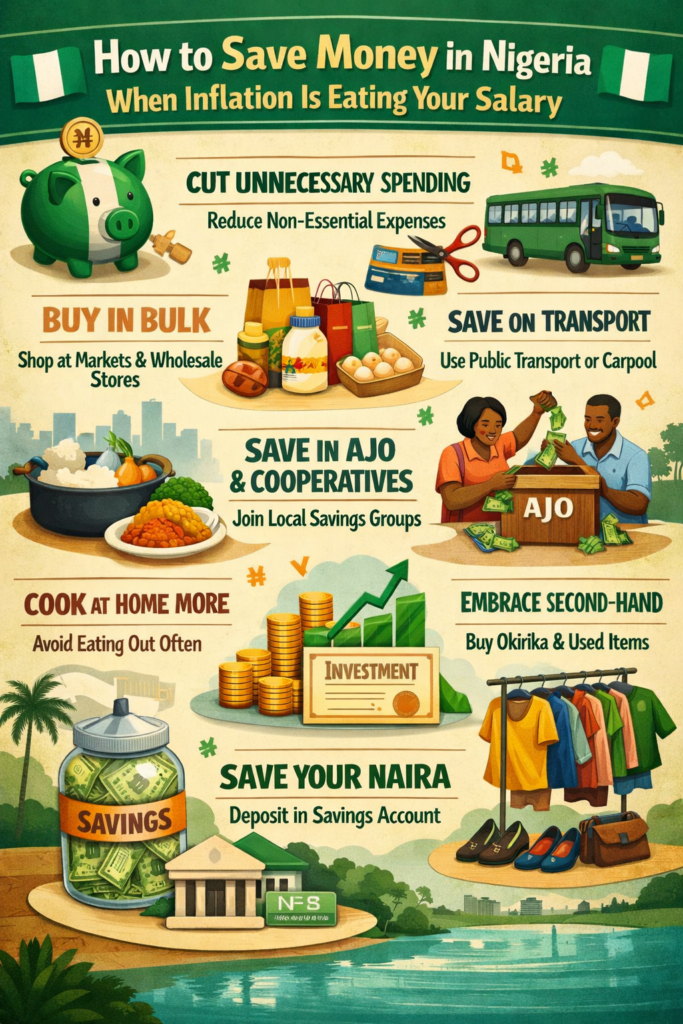
How to Save Money in Nigeria in 2026 (When Your Salary Is Not Enough)
Tolu earns ₦180,000 a month.
Two years ago, that salary felt manageable. Rent, food, transport, a little left over. Not rich but stable. Breathing room existed.
Today, the same ₦180,000 arrives on the 25th and is functionally gone by the 10th of the following month. Nothing changed in her lifestyle. Everything changed around it.
A bag of rice that cost ₦28,000 in 2023 now costs ₦75,000. Cooking gas that was ₦5,000 per cylinder is ₦18,000. Her transport fare to work doubled; the landlord added 60% to her rent renewal, and her salary went up by ₦20,000 only.
The mathematics of Nigerian inflation is not complicated. It is just brutal.
Here’s the truth: saving money in Nigeria in 2026 is not about cutting your morning coffee. It is about restructuring how money moves through your life, before inflation takes it. This post gives you the exact framework to do that.
First, Understand What You’re Actually Fighting
Before any strategy makes sense, you need to understand the enemy clearly.
Nigeria’s inflation is not a temporary blip. It is structural — driven by naira depreciation, fuel subsidy removal, import dependency, and food supply disruptions. The Central Bank of Nigeria has been raising interest rates to combat it, but monetary policy alone cannot fix supply-side problems.
What this means practically: the naira you hold today is worth less tomorrow. Consistently. Predictably. Which means the traditional Nigerian savings advice — “keep money in your savings account” — is actively working against you.
A savings account paying 4% interest while inflation runs at 30%+ is not saving. It is a slow leak.
Your strategy must do two things simultaneously: reduce what inflation takes from you and store value in forms that inflation cannot easily destroy. Everything in this post does one or both.
Part One: Stop the Bleeding — Fix Your Spending Architecture
The “Salary Ambush” Problem
Most Nigerians don’t overspend deliberately. They get ambushed.
The salary lands. Someone needs money. A bill arrives. Fuel runs out, then an emergency surfaces. By the time you think about saving, there is nothing left to save.
This is not a discipline problem. It is a structural problem. And structural problems need structural solutions.
Pay Yourself First — Non-negotiable
The single most effective money habit you can build in an inflationary environment is this: the moment your salary arrives, move your savings out before you spend anything.
Not at the end of the month. Not “whatever is left.” First, immediately, before you buy data, before you send money to your mother, before anything else.
Set a fixed amount, even if it is ₦10,000 or ₦15,000. Move it to a separate account the same day your salary arrives. Treat it like a deduction, not a choice.
The psychology here is simple but powerful. Money you cannot see, you cannot spend. Once it is in a separate account, especially one with withdrawal restrictions, your brain stops counting it as available.
The 50-30-20 Rule, Nigerian Edition
The classic budgeting framework — 50% needs, 30% wants, 20% savings was designed for economies with stable inflation. In Nigeria, you need an adjusted version:
20% — Savings and investments: Moved out on salary day, before anything else
20% — Everything else: Family obligations, discretionary spending, entertainment
The hard conversation is in that 60%. If your non-negotiables currently consume 85% of your income, the problem is not that you spend too much on entertainment. The problem is that your fixed costs are misaligned with your income. That requires either increasing income or restructuring fixed costs, particularly rent, which is typically the largest single line item.
Track Every Naira for 30 Days
Before you can fix your spending, you need to see it clearly.
For the next 30 days, write down every single expense. Every recharge card, okada or keke fare, Suya bought and even transfers to family. In fact, track everything.
Most people who do this exercise are genuinely shocked. Not because they discover one big problem, but because they discover twenty small ones that add up to a significant drain. ₦500 here, ₦1,200 there, a ₦3,000 subscription they forgot about — it accumulates fast.
Use a simple notes app on your phone. No need for a fancy budgeting application. Just a running list, every day, for one month. At the end, categorize and add up. The picture that emerges will tell you exactly where to cut.
Part Two: Kill the Expenses That Are Killing You Quietly
Audit Your Subscriptions Right Now
Open your bank statements for the last three months. Look for recurring debits, anything that charges you automatically every month.
Streaming services, App subscriptions, Gym memberships, Insurance policies you no longer need. Software trials that converted to paid plans. Automated savings apps you stopped using.
In naira terms, a ₦3,500 monthly subscription sounds negligible. At today’s exchange rates, that is roughly $2. But twelve of those subscriptions are ₦42,000 a year that’s more than some people’s monthly transport budget.
Cancel everything you haven’t actively used in the last 30 days. Not “might use.” Actually used.
The Generator Fuel Trap
For most Nigerian households and small businesses, generator fuel is one of the most significant and most overlooked drains on monthly income.
Running a 3KVA generator for 6 hours a day at current fuel prices costs approximately ₦30,000–₦40,000 per month, depending on your location and fuel source. Over a year, that is 360,000 – ₦480,000.
Practical strategies to cut this:
Shift your heaviest appliance use to NEPA hours. Charge laptops, run washing machines, and cook with electric appliances during grid supply, however unreliable it is.
Invest in an inverter system if your income allows. The upfront cost (₦250,000 – ₦400,000 for a decent setup) pays back in fuel savings within 12 – 18 months.
LED lighting throughout. A complete LED conversion and rechargeable lights in a three-bedroom flat costs under ₦30,000 and cuts generator use significantly.
Consolidate generator running hours with neighbours where possible. Generator-sharing arrangements in residential buildings are increasingly common in Lagos and Abuja and genuinely effective.
The “Family Tax” Conversation Nobody Wants to Have
Let’s talk about extended family financial obligations. Because for many Nigerian professionals, this is the single largest unbudgeted expense in their lives.
Siblings calling for school fees. Parents needing medical support. Cousins with business ideas. Uncles in emergencies. The requests are real, the relationships are real, and the financial pressure is also real.
There is no clean solution here. But there is a structured one.
Set a fixed monthly family support budget-an amount you decide in advance, not in response to requests. When the amount is used, it is used for that month. This is not selfishness. It is financial survival, and you cannot support anyone long-term if you are financially destroyed in the short term.
Communicate it plainly: “I have set aside ₦X every month for family support. That is what I can do consistently.” People respect clarity more than they respect vague availability followed by eventual inability to help.
Part Three: Save in Things Inflation Cannot Eat
Why Your Savings Account Is Losing You Money
A standard Nigerian commercial bank savings account currently pays between 1.15% and 4.2% interest annually, depending on the bank and account type.
Nigeria’s inflation rate has been running above 25% for an extended period.
The gap between those two numbers is the rate at which your savings account is destroying your purchasing power. Every naira sitting in a standard savings account is shrinking in real terms every single day.
This does not mean you should not save. It means you should not save in the wrong place.
High-Yield Options That Actually Make Sense
1. CBN Treasury Bills and FGN Bonds
Federal Government of Nigeria (FGN) securities, Treasury Bills, FGN Bonds, and FGN Savings Bonds, which currently offer yields significantly above commercial bank savings rates. As of 2026, 91-day Treasury Bill rates have been in the 18%-22% range at various auction cycles.
These are government-backed instruments. The default risk is as close to zero as anything in Nigeria gets.
Access them through:
Your commercial bank’s investment desk
A licensed stockbroker or investment platform
The CBN’s retail savings bond programme (minimum investment as low as ₦5,000 for FGN Savings Bonds)
2. Money Market Funds
Money market funds offered by licensed Nigerian fund managers, Stanbic IBTC, ARM, Meristem, Coronation, and others, invest in short-term government and corporate instruments and currently offer returns in the 18%-28% range annually, with daily liquidity.
Your money is not locked up. You can withdraw within 24-48 hours in most cases. The returns beat commercial bank savings rates significantly. And they are regulated by the Securities and Exchange Commission (SEC Nigeria).
This is where your emergency fund should live, not in a savings account earning 3%.
3. Dollar-Denominated Savings
Given the naira’s persistent depreciation against the dollar, saving a portion of your income in USD is a rational inflation hedge, not speculation; just preservation.
Options available to Nigerians:
Domiciliary accounts at any Nigerian commercial bank — open one, fund it in USD. Requires a minimum opening balance and a source of foreign currency (remittances, freelance income, etc.)
Dollar savings apps — platforms like Piggyvest (Flex Dollar), Bamboo, or Plutus Neo and Risevest allow Nigerians to save in USD digitally. Each has its own fee structure and terms, so read them carefully before committing significant funds.
A practical approach: convert 10%-20% of your monthly savings into USD. Not your entire savings, just a portion as a hedge. If the naira depreciates further (as it historically has), this portion retains its value in real terms.
4. Agricultural Commodity Investment
This is underused and genuinely effective for Nigerians with some capital and patience.
Platforms like ThriveAgric, Farmcrowdy, and similar agri-investment platforms allow individuals to fund farming cycles like rice, maize, poultry, and fish in exchange for returns at harvest. Typical returns range from 15%-25% per cycle, depending on the commodity and season.
The risks are real, such as weather, logistics, platform operational risk, etc. So do not put money that you cannot afford to lock up for the farming cycle, usually for a duration (typically 3-9 months). But as one component of a diversified savings strategy, agricultural investment has strong historical performance in Nigeria precisely because food prices rise with inflation.
Part Four: The Bulk-Buying Strategy That Nigerians Already Know (But Underuse)
Buy Ahead of the Price Increase
Inflation in Nigeria is not random. It follows predictable patterns — driven by harvest seasons, exchange rate movements, and fuel price adjustments. A naira spent today on a non-perishable good is almost always cheaper than the same naira spent in three months.
This is not hoarding. It is rational purchasing behaviour in an inflationary environment.
What to bulk-buy:
Rice, beans, garri, and other dry staples, buy in 25kg or 50kg bags when prices are stable, typically just after harvest season (October – December for most northern crops)
Cooking oil prices track the dollar. Buy several litres when the exchange rate is relatively favourable
Toiletries and cleaning products such as soaps, toothpaste, detergent. These don’t expire quickly, and the price trajectory is consistently upward
Canned and packaged goods with long shelf lives
What not to bulk-buy: Anything perishable that you cannot store properly, anything with a short shelf life, or anything you are buying on credit. Bulk-buying on debt defeats the purpose entirely.
The Market vs. Supermarket Price Gap
Here’s a fact that Lagos and Abuja residents often forget: the price gap between open-air markets and supermarkets for identical food items in Nigeria is often 30%–60%.
A 5kg bag of tomatoes in a big supermarket or store costs significantly more than the same tomatoes at Mile 12 Market or Orange Market. The tomatoes are the same.
For staple food shopping, going to the market or ordering directly from market traders through WhatsApp groups, which is now extremely common in Lagos, saves a meaningful amount monthly. For a household spending ₦60,000 monthly on food, a 40% reduction from market sourcing is ₦24,000 in annual savings. On food alone.
Part Five: Earn More, Because Saving Alone Won’t Win This Fight
Let’s be honest about the ceiling.
If you earn ₦150,000 a month in a city like Lagos, and your genuine non-negotiable costs are ₦130,000, the savings problem is not really a savings problem. It is an income problem. You can cut and optimise all you want, but you cannot squeeze meaningful savings out of a 13% margin.
At some income levels, the primary solution is not to save harder. It is to earn more.
Skills That Pay in Dollars (or Euros, or Pounds)
The most powerful financial hedge available to a Nigerian professional today is earning in foreign currency while living in naira.
Remote work opportunities have expanded dramatically. The following skills currently command international clients and dollar-denominated income:
Technical writing and content creation, particularly for SaaS companies, legal tech, and financial services
Software development-frontend, backend, mobile
UI/UX design– platforms like Toptal, Dribbble, and LinkedIn regularly host international opportunities
Digital marketing and SEO-performance marketing skills transfer globally
Virtual assistance and operations-high-level executive VA work pays $1,500 – $4,000 per month remotely
Legal and compliance consulting-Nigerian lawyers with expertise in corporate law, IP, or fintech regulation are increasingly sought by international companies operating in West Africa
Platforms to explore: Toptal, Contra, Deel, Remote.com, LinkedIn (filter for remote roles), and direct outreach to international companies with Nigerian or African operations.
Even one dollar-denominated client generating $200 – $500 monthly transforms the financial picture at current exchange rates.
The Side Income That Actually Fits Your Life
Not everyone has the energy to build a freelance career on top of a full-time job. That is real, and it is fair.
But side income does not have to be a second career. It can be a single recurring revenue stream that you build once and maintain with modest effort.
Examples that work in the Nigerian context:
Tutoring: academic tutoring for secondary school or university students, or professional skills tutoring (Excel, graphic design, accounting). WhatsApp-based coordination, paid per session.
Reselling: buying goods directly from manufacturers or importers at wholesale and reselling at retail margins. This works especially well for cosmetics, fashion accessories, and food items.
Content creation: a monetized YouTube channel or TikTok account in a niche you already know. Takes 6-18 months to become a meaningful income, but the compounding effect is real.
Professional services on weekends: if you are a lawyer, accountant, doctor, engineer, or HR professional, there are individuals and small businesses who need your skills but cannot afford a firm’s rates. Weekend consulting, properly structured, can generate ₦50,000 – ₦200,000 monthly.
Pick one. Build it to stability before starting another. The biggest side income mistake Nigerians make is starting five things and finishing none of them.
The One Number You Need to Know Every Month
At the end of each month, calculate this:
Net Savings Rate = (Amount Saved ÷ Total Income) × 100
That percentage is your financial health indicator. In a high-inflation environment, a savings rate below 15% means inflation is winning. A savings rate above 25% — even at modest income levels — means you are building forward momentum.
Track it monthly. Not to judge yourself. To see the trend. If it is going up over six months, the strategy is working. If it is consistently flat or declining, something in the structure needs to change.
One number. Every month. That discipline alone puts you ahead of 80% of Nigerians trying to manage money without a system.
The Bottom Line is:
Inflation is not going to apologise to your salary. The government is not going to fix your household budget. The naira is not going to reverse course on your timeline.
What you can control is the architecture of how money moves through your life: where it goes the moment it arrives, what form you store it in, and how hard you work to bring more of it in.
None of the strategies in this post requires a financial advisor, a large income, or a perfect economy. They require a decision made today, not next month, to stop letting inflation happen to you passively.
Start with one thing. The “pay yourself first” rule. Today. Right now.
Nigerian Police Stop and Search: Know Your Exact Legal Rights
You are driving home.
Or walking down the street.
Suddenly, a police officer signals you to stop.
Your heart starts racing.
What happens next?
Can they search your phone or your car?
Can they force you to answer questions?
Are you going to be arrested for refusing to pay a bribe?
Many Nigerians are unsure about their rights during a police stop-and-search.
That uncertainty can lead to fear, confusion, and sometimes abuse.
The good news is that the law gives you rights.
Knowing those rights can help you stay calm, protect yourself, and avoid unnecessary trouble.
This guide explains exactly what to do if Nigerian police stop you and what your legal rights are during a stop-and-search.
Can Nigerian Police Stop You?
Yes.
The police can stop individuals and vehicles in certain situations.
This may happen during:
Routine patrols
Security operations
Roadblocks
Criminal investigations
Traffic enforcement
Being stopped does not mean you have committed a crime.
Sometimes officers are conducting routine checks.
Stay Calm First
Your first reaction matters.
Do not:
Argue aggressively
Shout at officers
Resist physically
Make sudden movements
Instead:
Remain polite
Keep your hands visible
Speak calmly
Follow lawful instructions
Being respectful does not mean giving up your rights. It simply helps keep the situation under control.
What Are Your Rights During a Police Stop?
You Have the Right to Know Why You Were Stopped
A police officer should be able to explain why you are being stopped.
You can politely ask:
“Officer, may I know why I have been stopped?”
This is a reasonable question.
It is not disrespectful.
Understanding the reason helps you know what is happening.
You Have the Right to Be Treated With Respect
Every Nigerian has the right to dignity.
This means police officers should not:
Assault you
Humiliate you
Use abusive language
Threaten you unnecessarily
Respect should go both ways.
You should remain respectful as well.
You Have the Right to Remain Silent
This surprises many people.
You do not have to answer questions that may incriminate you.
You may politely say:
“I would prefer to speak in the presence of my lawyer.”
You should provide basic identifying information when legally required.
However, you are not required to confess to a crime or make statements against yourself.
Can the Police Search You?
Yes, under certain circumstances.
Police officers may conduct a search if they reasonably suspect:
You possess illegal items.
You are involved in criminal activity.
You may be carrying a weapon.
However, the search should not be abusive or excessive.
Can Nigerian Police Search Your Phone?
This is one of the most common questions Nigerians ask.
The short answer is:
Not automatically.
Your phone contains private information.
In many situations, officers should have a lawful basis for demanding access to your phone.
What You Should Do
Remain calm.
Ask politely:
“Officer, under what authority are you requesting access to my phone?”
Do not become confrontational.
Do not physically resist.
If the situation escalates, comply peacefully and document what happened later.
Never attempt to destroy evidence or obstruct an investigation.
Can Police Search Your Vehicle?
Yes.
Police may inspect a vehicle during lawful operations or where there is reasonable suspicion.
If your vehicle is searched:
Stay calm.
Observe the process.
Avoid interfering.
Take note of the officers involved.
Do not physically obstruct a search.
That may create additional problems.
Do You Have to Pay Money at a Checkpoint?
No.
There is no law requiring motorists or pedestrians to pay money at checkpoints.
If an officer requests money without a lawful basis:
Remain polite.
Do not argue aggressively.
Do not offer a bribe.
Request clarification if necessary.
Offering a bribe can also be a criminal offence.
What If Police Want to Arrest You?
An arrest does not automatically mean guilt.
If you are arrested:
You Have the Right to Know Why
Ask:
“Officer, why am I being arrested?”
You should be informed of the reason for your arrest.
You Have the Right to Contact a Lawyer
One of your most important rights is access to legal representation.
Request to contact your lawyer as soon as possible.
You Have the Right to Contact Family
You may notify a family member or trusted person about your situation.
You Have the Right to Remain Silent
You are not required to make a statement immediately.
Consider speaking with a lawyer first.
What Should You Never Do During a Police Stop?
Even when you believe an officer is wrong, avoid these mistakes:
Do Not Resist Arrest
Physical resistance can worsen the situation.
Do Not Fight Officers
Disputes should be handled through legal channels.
Do Not Insult Officers
Insults can escalate tension unnecessarily.
Do Not Attempt to Bribe Anyone
Bribery creates legal risks for everyone involved.
Do Not Flee
Running away may create suspicion and increase danger.
What Information Should You Record?
If you believe your rights were violated, try to record details such as:
Officer’s name
Badge number
Police station
Patrol vehicle details
Location
Date and time
Witness information
Documenting details can be helpful if a complaint becomes necessary.
How to File a Complaint Against Police Misconduct
If you experience misconduct, you may consider reporting it through:
The Nigeria Police Force complaint channels
Human rights organizations
Legal practitioners
Relevant oversight bodies
Provide as much information as possible because facts and evidence matter.
A Simple Stop-and-Search Checklist
If Nigerian police stop you:
If Nigerian police stop you:
Stay calm
Be respectful
Ask why you were stopped
Keep your hands visible
Know your right to remain silent
Request a lawyer if necessary
Document important details
Do not resist or fight
Never offer a bribe
Do not make false statements
Just Remember
Most encounters with police officers end without problems.
The key is knowing your rights before you need them.
Stay calm and respectful.
Know what the law allows and what the law does not allow.
The more informed you are, the better equipped you will be to protect yourself during a stop and search because confidence comes from knowledge, not confrontation.
How to Renew Nigerian Passport Online in 2026 (No Agent Needed)
The ₦150,000 Lesson Nobody Should Have to Learn
Chukwuemeka had six weeks before his visa interview at the British High Commission in Lagos.
His passport expired eight months earlier. He knew he needed to renew it. He just kept postponing — work, kids, the general chaos of Lagos life. Then the appointment letter arrived and panic set in.
A colleague at the office smiled. “Don’t worry. I know a guy.”
The guy charged ₦150,000. Cash. Promised delivery in two weeks. Collected the money, the old passport, and Chukwuemeka’s birth certificate. Then disappeared for three weeks, calls diverting, WhatsApp ticks stubbornly grey.
The passport eventually came. One day before the visa interview. Two weeks late. With a data page error that took another week to fix.
The entire process from start to finish took 47 days and cost ₦150,000 for a 32-page booklet (5-year validity), plus a rescheduled visa appointment fee.
The official online process, when done correctly, takes the same amount of time. Costs a fraction. Requires zero middlemen.
This is that guide.
Why People Still Pay “Run-Men” in 2026
Let’s be honest about this.
The Nigerian Immigration Service (NIS) has had an online passport application portal for years. It works. It is not perfect; no government portal in any country is, but it is functional, and millions of Nigerians have used it successfully without paying a single kobo to an agent.
The run-man economy survives for three reasons.
One: People don’t know the exact process and are afraid of making expensive mistakes with government forms.
Two: The portal has quirks such as browser compatibility issues, payment gateway hiccups, and document upload requirements that aren’t clearly explained, which frustrate first-timers into giving up.
Three: Agents are everywhere at passport offices, and they are very good at creating the impression that without them, nothing will move.
None of these is a reason you need to pay anyone.
What you need is the correct information, in the right sequence. That is what this post gives you.
Before You Start: Know Which Process Applies to You
Not all passport renewals follow the same path. Get this wrong and you waste time.
Standard Renewal (most people): Your passport has expired or will expire within six months. You are in Nigeria. You want a new 32-page or 64-page booklet. This is the online process we are covering in detail.
Renewal Abroad: You are outside Nigeria. The process runs through Nigerian Embassies and High Commissions, although some now offer online pre-application, and physical appearance is still required at the mission. This guide does not cover that route fully so contact your nearest Nigerian mission for their specific procedure.
Emergency/Express Passport: For genuine emergencies, a death abroad, a medical trip, or imminent travel within 72 hours, the NIS has an emergency procedure. It costs more and requires physical appearance with supporting documents. An agent cannot speed this up; the NIS controls the timeline entirely.
Lost or Stolen Passport: A different process involving a police report, affidavit, and additional documentation. Do not use the standard renewal portal for a lost passport. Confirm which category applies to you before you proceed.
What You Need Before You Open the Portal
Gather everything first. Half the people who abandon the portal midway do so because they didn’t have a document ready and lost their session.
Documents required:
Current or most recent expired Nigerian passport (you will need the passport number and biodata details)
National Identification Number (NIN) — this is now mandatory. No NIN, no passport. Full stop.
Valid means of identification (National ID card, driver’s licence, or voter’s card)
Birth certificate or age declaration (for first-time applicants; renewals typically don’t require this unless specifically requested)
Passport photographs — white background, recent, taken within the last three months. The portal allows photo upload but you will also bring physical copies to the appointment.
Technical requirements:
A working email address you actually check — all portal communications go here
A working Nigerian phone number for OTP verification
A debit card or bank account for online payment (Mastercard, Visa, or Verve — all work on the NIS portal)
A laptop or desktop computer. Do the application on a PC, not a phone. The portal is not mobile-optimised and phone sessions time out aggressively.
Use Google Chrome or Mozilla Firefox. Internet Explorer and Safari create compatibility problems. Stick to Chrome.
Step-by-Step: The Exact Online Renewal Process
Step-by-Step: The Exact Online Renewal Process
Step 1: Go to the Official NIS Portal — And Only the Official Portal
The official Nigerian Immigration Service passport portal is:
Bookmark it. Screenshot it. That URL is the only one you should use.
There are clone sites, some convincing, some obviously fraudulent, that harvest your personal data and payment details. They rank on Google and look official, but they are not.
If a site asks for your NIN, date of birth, passport number, and payment information but the URL does not match the official NIS domain, close it immediately.
Step 2: Create Your Account
Click “Apply Now” and select “New Applicant” if you have never used the portal before, or “Existing Applicant” if you have a previous account.
For a new account, you will provide:
Full name (exactly as it appears on your existing passport and NIN)
Email address
Phone number
A password
An OTP will be sent to your phone number for verification. Enter it within the time window, it expires quickly. If it doesn’t arrive within 60 seconds, use the resend option once. If it still doesn’t arrive, check that the phone number you entered is correct and active.
Once verified, your account is created. Log in immediately and complete your profile before doing anything else.
Step 3: Start Your Application — Select the Right Options
After logging in, click “Apply for Passport” and select:
Application Type: Renewal
Passport Type: Standard (for the regular green booklet)
Booklet Type: 32 pages or 64 pages
Which booklet should you choose?
If you travel frequently, more than three or four times a year, or to multiple countries, go for 64 pages. The fee difference is modest and running out of visa pages is an avoidable frustration. If you travel rarely, 32 pages is sufficient.
Step 4: Fill the Application Form — Carefully and Exactly
This is where most errors happen.
The form asks for your biodata: name, date of birth, place of birth, state of origin, local government area, gender, and contact details. Every single entry must match your NIN record exactly.
This is not a suggestion. It is a requirement.
The NIS system cross-checks your application data against the NIMC (National Identity Management Commission) database in real time. A name discrepancy, even a missing middle name or a different spelling, will flag your application and may result in rejection or delays at the passport office.
If your NIN record has an error, fix it at NIMC before you apply for the passport. Trying to work around it in the passport application will not end well.
Additional form sections include:
Next of kin details — name, address, relationship, phone number
Guarantor information — a Nigerian citizen with a valid passport who can vouch for your identity. For renewals, this requirement is less strictly enforced than for first-time applications, but have the details ready.
Previous passport details — enter your current or most recently expired passport number, issue date, and place of issuance exactly as printed in the passport.
Review every field twice before proceeding. You cannot easily edit a submitted application.
Step 5: Upload Your Photograph
The portal requires a digital passport photograph upload meeting the following specifications:
White background — not cream, not grey, not light blue. White.
Full face, front-facing, no glasses, no head covering (except for religious reasons)
Neutral expression, mouth closed
File format: JPEG or JPG
File size: between 10KB and 50KB
Dimensions: approximately 200 x 200 pixels
Practical tip: Have a photographer take your passport photo and ask them to give you a white-background digital copy on a USB drive or via WhatsApp. Many passport photographers in Nigeria now provide digital copies as standard. Confirm the file size before you leave their shop. Photos larger than 50KB will be rejected by the portal, and you will need to compress and re-upload them.
Free online tools like ilovephoto.com or Compress JPEG can reduce file size without significantly affecting quality.
Step 6: Select Your Passport Office and Appointment Date
After submitting your form and photo, you will select:
The NIS passport office where you will appear for biometric capture
Your preferred appointment date and time slot
Choose your passport office wisely. Major offices, Ikoyi (Lagos), Abuja headquarters, Port Harcourt have higher application volumes, and appointment slots fill up quickly. If you are in Lagos and flexibility allows, consider selecting a less congested office in Ikeja or even Ikorodu, where appointment availability is often better.
Select the earliest available slot that works for your schedule. Do not book an appointment you cannot keep; rescheduling is possible but adds unnecessary delay.
Screenshot your appointment confirmation immediately. The system will also send it to your email, but government portal emails sometimes land in spam. Check your spam folder.
Step 7: Pay the Official Fee
After selecting your appointment, you will be directed to the payment page.
Official NIS passport fees (as of 2026):
32-page standard passport: ₦100,000
64-page standard passport: ₦200,000
These are the official government fees. You pay them on the portal. You pay them nowhere else.
Payment methods accepted on the NIS portal:
Debit card (Mastercard, Visa, Verve)
Internet banking (via Remita — the government’s payment gateway)
Bank branch payment (Remita Reference Number generated on portal, paid at any commercial bank)
If your card payment fails on the first attempt, which happens because Remita can be temperamental — wait five minutes and try again. Do not attempt the payment multiple times in quick succession; multiple deductions can occur and reversals take time.
If you prefer to avoid card issues entirely, use the Remita Reference Number route: generate the reference on the portal and walk into any GTBank, Access Bank, Zenith Bank, or First Bank branch to pay cash over the counter. Bring the reference number printed or on your phone. The payment reflects on the portal within 24 hours.
After successful payment, download and print your payment receipt and your application summary. Both go with you to your appointment.
Step 8: Attend Your Appointment
On your appointment day, arrive at the passport office at least 30 minutes early.
Bring the following in a neat folder, not stuffed in a bag:
Printed appointment confirmation slip
Printed payment receipt
Completed application summary printout
Current or expired passport (original)
NIN slip or National ID card (original)
Two recent passport photographs (physical copies, white background)
Any other supporting documents specified during your application
At the passport office, you will go through:
Document verification — an NIS officer checks that your documents match your online application
Biometric capture — fingerprints (all ten fingers) and a live photograph
Data confirmation — you review your data on screen and confirm it is correct
This entire process at the office typically takes 30 – 90 minutes if you arrive at your scheduled time with complete documents. If your documents are incomplete, you will be turned away and required to reschedule. There is no “managing” your way through with incomplete paperwork.
Important: Do not bring cash to “assist” the process. Officers who solicit bribes can be reported to the NIS Public Complaints Unit. The process is designed to work without facilitation payments. If an officer suggests otherwise, note their name or badge number.
Step 9: Track Your Application
After your biometric appointment, your passport goes into production.
Track the status of your application on the NIS portal:
https://passport.immigration.gov.ng → Login → Application Status
Status updates move through: Submitted → Biometrics Captured → Processing → Ready for Collection / Dispatch.
Realistic production timelines in 2026:
Standard processing: 4 – 6 weeks from biometric appointment
Express processing: 2 – 3 weeks (where available — check with your specific passport office)
These timelines assume no data issues, no system backlog at the NIS booklet production centre, and no public holidays clustering in that window. Practically, allow eight weeks from appointment to collection if you want a stress-free buffer.
Step 10: Collection or Delivery
You have two options for receiving your completed passport:
Option 1: Collect at the passport office: You receive an SMS and/or email notification when your passport is ready. Return to the office with your collection slip and a valid ID. Collection is usually straightforward.
Option 2: Home delivery via NIPOST: The NIS offers a home delivery option through NIPOST (Nigerian Postal Service) at an additional fee selected during the application. Delivery covers most Nigerian states, but timelines vary significantly by location. Lagos and Abuja deliveries are generally faster than remote states.
If you opt for delivery, ensure your address is precise — street name, house number, landmark. NIPOST delivery agents will not search for you. A wrong address means a returned passport and a collection trip anyway.
The Most Common Portal Problems — And How to Fix Them
Problem: “NIN not found” error during application
Fix: Verify that your NIN is active and your NIMC record is updated. Visit any NIMC enrolment centre with your NIN slip and valid ID to confirm your record is complete.
Problem: Payment deducted but portal shows “payment pending”
Fix: Wait 24 hours for Remita to reconcile. If it doesn’t clear, take your bank debit alert and payment reference to the NIS passport office on your appointment day — the accounts desk can manually verify and clear the payment.
Problem: Photo upload rejected
Fix: The file size or background colour is almost certainly the issue. Use an online compression tool to bring the file under 50KB and ensure the background is pure white (RGB 255, 255, 255).
Problem: Appointment slots show as fully booked
Fix: Check back early in the morning; slots are released on a rolling basis, and cancellations free up slots daily. Alternatively, try a different passport office within a reasonable distance.
Problem: Portal times out mid-application
Fix: Use Chrome, clear your cache before starting, and type all your information in a Word document so you can paste quickly. Avoid applying on mobile data. A stable WiFi or broadband connection reduces timeout risk significantly.
What the Run-Man Cannot Do That You Think He Can
Let’s put this to rest.
A passport agent, the legitimate kind, not the fraudulent ones, is essentially just a person who knows the process and completes it on your behalf. They have no special access to the NIS system and don’t have a back channel that accelerates production; neither can they jump the biometric queue for you. The passport production timeline is the same whether you applied yourself or paid someone to do it.
What they do is fill in the online form, book the appointment, and escort you to the office. That is it. You can do all of that yourself in about 45 minutes with this guide. The only thing an agent “speeds up” is the part where you have to think. And thinking, in this case, is free.
One Final Word Before You Close This Tab
Start the process today.
Not when your passport is about to expire. Not when you have a trip booked. Today! Right now, while the information is fresh and the motivation is present.
The entire online process takes less than an hour to complete. The appointment and production time runs on the NIS clock, not yours, and that clock does not start until you apply.
Every week you wait is a week added to the end of your timeline. And the agent is counting on that delay. He is banking on your procrastination turning into his commission.
Don’t give it to him.
Have questions about a specific step or a portal error you’ve encountered? Drop it in the comments. If I’ve seen it — and I’ve seen most of them — I’ll tell you exactly how to fix it.
A dynamic burst of radiant blue and white light beams
Understanding Intellectual Property Rights: What Every Nigerian Entrepreneur Must Know
“Your Idea Is Not Safe Until You Do This”
Imagine spending three years building a business.
You invest your savings.
Next, you create a unique brand name.
Then, you design a logo.
Finally, you build a loyal customer base.
Only to discover one morning that another business is using a similar name, a similar logo, and selling almost the same product.
You rush to challenge them.
But there is one problem.
You never protected your intellectual property.
This situation happens more often than many Nigerian entrepreneurs realize.
The truth is simple: your ideas, brand, content, and innovations are valuable business assets. If you do not protect them, someone else may profit from your hard work.
That is why understanding intellectual property rights is not just for lawyers. It is an essential business skill.
In this guide, you will learn what intellectual property rights are, how they work in Nigeria, and the practical steps you can take to protect your business.
What Are Intellectual Property Rights?
Intellectual Property Rights (IP Rights) are legal protections for creations of the mind.
These rights allow individuals and businesses to control how their ideas, inventions, creative works, and brands are used.
Think of intellectual property as ownership of your creativity.
Just as you can own land, a house, or a vehicle, you can also own certain business ideas and creative works.
For many modern businesses, intellectual property is often more valuable than physical assets.
Why Intellectual Property Matters for Nigerian Entrepreneurs
Many business owners focus on sales, marketing, customer service, and growth.
Few pay attention to intellectual property.
That can be an expensive mistake.
Without proper protection:
Someone can register a similar brand name.
Competitors can copy your product design.
Your content can be reproduced without permission.
Investors may see your business as vulnerable.
You may lose exclusive rights to your own creations.
Industrial design protection covers the visual appearance of products.
This may include:
Shapes
Patterns
Decorative features
Packaging designs
For example, a unique perfume bottle or fashion accessory design may qualify for protection.
Industrial designs protect how a product looks, not how it works.
Trade Secrets: The Hidden Business Asset
Many entrepreneurs focus only on trademarks and copyrights.
They forget about trade secrets.
Trade secrets can include:
Recipes
Customer databases
Manufacturing methods
Supplier information
Pricing strategies
Business processes
Unlike patents, trade secrets do not require registration.
However, they require strong protection.
How to Protect Trade Secrets
Use confidentiality agreements.
Limit access to sensitive information.
Include confidentiality clauses in employment contracts.
Restrict access on a need-to-know basis.
Some trade secrets remain valuable for decades.
Intellectual Property in the Digital Age
Today’s businesses create intellectual property every day.
Your:
Website
Mobile app
Social media content
Online courses
Digital products
Marketing campaigns
are all valuable assets.
Who Owns Social Media Content?
If a freelancer or agency creates content for your business, ownership should be clearly stated in a written agreement.
Never assume ownership automatically transfers.
Domain Names Matter Too
Many Nigerian businesses protect their trademarks but ignore domain names.
Registering your business domain early can prevent costly disputes later.
AI-Generated Content and Intellectual Property
Artificial intelligence is changing content creation.
Many entrepreneurs now use AI tools for:
Articles
Graphics
Marketing materials
Videos
This creates new questions about ownership.
Current laws continue to evolve in this area.
The safest approach is to ensure substantial human input and creative contribution when producing content intended for commercial use.
Signs Your Business Needs Intellectual Property Protection
You should seriously consider intellectual property protection if:
You have a recognizable brand.
You created original content.
You built software.
You developed a product.
You run an e-commerce business.
You own valuable business information.
You plan to attract investors.
If your business depends on creativity, innovation, or branding, intellectual property matters.
What To Do If Someone Copies Your Work
Discovering that someone has copied your intellectual property can be frustrating.
However, rushing into court is not always the best first step.
Practical Steps
Gather evidence.
Document the infringement.
Consult an intellectual property lawyer.
Send a cease-and-desist letter.
Explore negotiation if appropriate.
Consider legal action where necessary.
Many intellectual property disputes are resolved through negotiation before reaching court.
The goal is to protect your business, not simply to win an argument.
Common Intellectual Property Mistakes Entrepreneurs Make
Assuming Ideas Alone Are Protected
An idea alone is usually not enough.
Protection becomes stronger when ideas are documented, developed, and legally protected.
Delaying Registration
Waiting until your business becomes successful can be risky.
Someone else may act first.
Ignoring Contracts
Poor contracts create ownership disputes.
Always use written agreements.
Copying Content Online
Using content from Google or social media without permission can create legal exposure.
Always use original content or obtain proper authorization.
Can Intellectual Property Make You Money?
Absolutely.
Many successful businesses generate significant income through intellectual property.
Examples include:
Licensing trademarks
Licensing software
Selling copyrights
Franchising brands
Commercializing inventions
Investors often view strong intellectual property protection as a sign of a well-managed business.
The stronger your intellectual property portfolio, the more valuable your business may become.
In a Nutshell
Your intellectual property is not just paperwork.
It is not just a legal issue.
It is a business asset.
Your brand, content, inventions and designs.
These are often the very things that make customers choose you over competitors.
The earlier you protect them, the easier it becomes to grow your business, attract investment, and build long-term value.
This week, identify one intellectual property asset your business owns and take one concrete step to protect it.
Your future self will thank you.
Quick Question
Which of these applies most to your business right now?
Trademark
Copyright
Patent
Trade Secret
Leave a comment below and share your experience.
Disclaimer: This article is provided for informational purposes only and does not constitute legal advice. Readers should seek professional advice for their specific circumstances.