Author: lexnuellegalconsult@gmail.com

  • Free Simple Contract Template

    Free Simple Contract Template

    A free Simple Contract Template Every Nigerian Freelancer and Business Owner Should Have

    There’s a particular kind of stress that comes from hearing:

    “But that’s not what we agreed.”

    Most business disputes do not begin with bad intentions. They begin with assumptions.

    One person remembers one version of the conversation. The other remembers something completely different.

    That is why written agreements matter.

    Not because you expect problems. Because clarity protects everyone.

    Below is a simple, beginner-friendly contract template you can adapt for freelance work, small business transactions, collaborations, or service agreements in Nigeria.

    Simple Service Agreement Template (Nigeria)

    Important Note:
    This template is for educational purposes and should be adapted to suit your specific transaction. For high-value or sensitive agreements, consult a qualified legal practitioner.

    SERVICE AGREEMENT

    This Agreement is made on this ___ day of __________ 20___ between:

    Party A

    Name: __________________________
    Address: ________________________
    Phone Number: __________________

    AND

    Party B

    Name: __________________________
    Address: ________________________
    Phone Number: __________________

    Both parties agree as follows:

    1. Scope of Work

    Party A agrees to provide the following services:


    The services shall be completed on or before:

    Delivery Date: ___________________

    2. Payment Terms

    The total agreed fee for the services is:

    ₦__________________

    Payment shall be made as follows:

    • Initial Deposit: ₦______________
    • Balance Payment: ₦______________

    Payment method:


    3. Responsibilities of Both Parties

    Party A Shall:

    • Deliver the agreed services professionally
    • Meet agreed timelines
    • Communicate progress when necessary

    Party B Shall:

    • Provide necessary information/materials
    • Make payments as agreed
    • Respond to communications promptly

    4. Confidentiality

    Both parties agree not to disclose confidential information shared during the course of this agreement unless required by law.

    5. Delay or Failure to Perform

    If either party is unable to fulfill their obligations due to circumstances beyond their control, they shall notify the other party immediately.

    6. Termination

    Either party may terminate this agreement by providing written notice of ___ days.

    Where termination occurs:

    • Payment shall be made for completed work
    • Outstanding obligations shall remain enforceable

    7. Dispute Resolution

    Any dispute arising from this agreement shall first be resolved amicably through discussion.

    Where resolution fails, the parties may explore mediation or legal action under Nigerian law.

    8. Governing Law

    This Agreement shall be governed by the laws of the Federal Republic of Nigeria.

    SIGNED BY:

    Party A

    Name: ___________________

    Signature: _______________

    Date: ____________________

    Party B

    Name: ___________________

    Signature: _______________

    Date: ____________________

    Why Simple Contracts Like This Matter

    A lot of Nigerians avoid contracts because they think agreements must sound complicated to be valid.

    That is not true.

    A good contract is not about using intimidating language.
    It is about making expectations clear before confusion begins.

    Sometimes, one page can prevent months of stress.

    Common Mistakes People Make With Contracts

    1. Leaving Payment Terms Vague

    “Payment will be made later” is not a payment plan.

    Write exact amounts and dates.

    2. Failing to Include Deadlines

    Without timelines, delays become difficult to challenge.

    3. Relying Only on WhatsApp Chats

    Chats help, but a signed agreement creates stronger legal clarity.

    4. Copying Random Templates Online

    Not every foreign contract works under Nigerian law.

    Always review carefully.

    Final Thoughts

    Contracts are not signs of distrust.

    They are signs of maturity.

    The truth is simple:
    People work better together when expectations are clear from the beginning.

    And sometimes, the most professional thing you can say is:

    “Let’s put it in writing.”

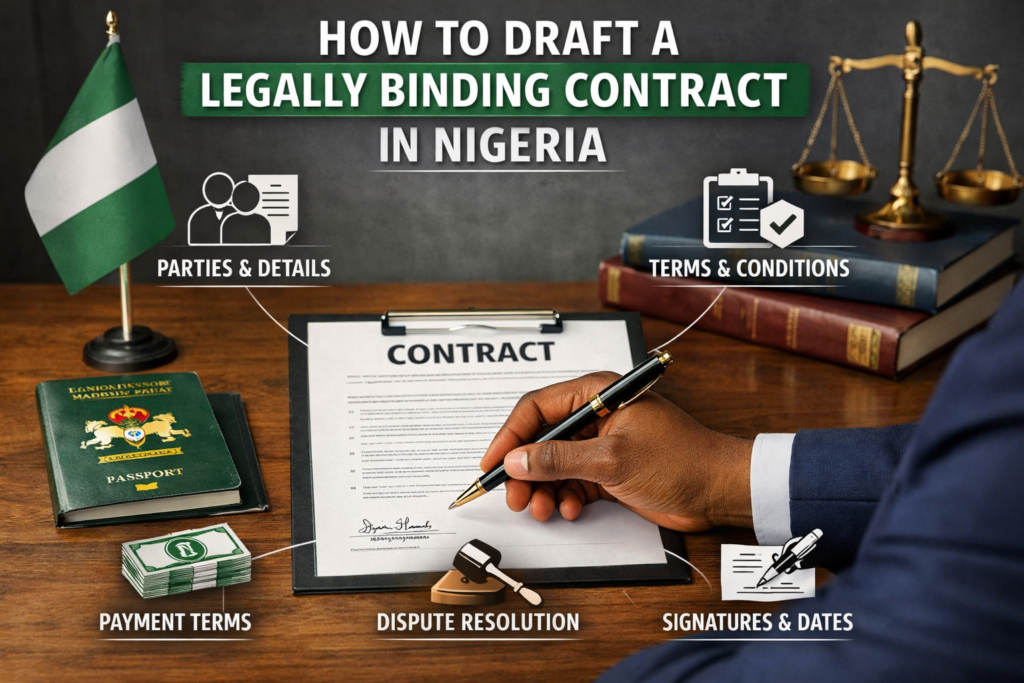
  • How to Draft a Legally Binding Contract in Nigeria

    How to draft a legally binding contract in Nigeria

    The Contract was “fine” until the money disappeared: How to Draft a Legally Binding Contract that actually protects you in Nigeria

    The first thing she noticed was the silence.

    Not the peaceful kind. The dangerous kind.

    Three months earlier, the tailor shop had been buzzing — sewing machines rattling, generators coughing in the background, customers drifting in and out with wedding fabrics wrapped under their arms. But now the chairs were empty. Her supplier had disappeared with nearly half a million-naira worth of materials, and every phone call ended the same way:

    “Madam, we didn’t agree like that.”

    She kept repeating one sentence like it could rewind time.

    “But we had an agreement.”

    The problem was that the agreement lived in WhatsApp voice notes and vague promises. No written contract, no signatures and no clear payment terms. Just trust stretched too thin.

    And here’s the uncomfortable truth nobody tells you early enough in business or even personal transactions in Nigeria:

    A handshake is warm.
    A contract is warmer.

    Because when things go wrong — and sometimes they do — memory becomes slippery. People suddenly remember conversations differently. Deadlines become “suggestions.” Payments become “misunderstandings.”

    That’s usually the moment people start searching frantically:

    “How do I draft a legally binding contract in Nigeria?”

    Not before the problem. After the damage.

    I know because I’ve made that mistake too. Years ago, I once worked on a small project without insisting on a proper agreement because I didn’t want to “look difficult.” I thought professionalism meant flexibility.

    It cost me weeks of stress and one painful lesson:

    Clarity is kinder than assumption.

    Why Contracts Feel Intimidating (Even to Smart People)

    Most people hear the word contract and immediately picture:

    • intimidating legal jargon,
    • pages thick enough to stop a bullet,
    • and lawyers charging fees that make your chest tighten.

    So they avoid it.

    Instead, they download random templates online. Or worse, they scribble vague terms on paper and hope for the best.

    The trouble is that Nigerian law doesn’t care about what you meant. It cares about what you can prove.

    And that changes everything.

    The Moment the Whole Thing Finally Clicks

    A good contract is not about sounding smart.

    That’s the part many people get wrong.

    A contract is simply a written record of:

    • who is doing what,
    • when they’ll do it,
    • how much is involved,
    • and what happens if someone fails to keep their word.

    That’s it.

    Once you stop trying to sound like a courtroom drama and start aiming for clarity, drafting a contract becomes far less frightening.

    In fact, the best contracts are often the easiest to read.

    So, What Makes a Contract Legally Binding in Nigeria?

    Under Nigerian law, a contract generally becomes enforceable when a few basic conditions are met.

    Simple things. Human things.

    1. Somebody Must Make an Offer — And Someone Must Accept It

    This sounds obvious until you see how many disputes begin with blurry communication.

    If a graphic designer says:

    “I’ll design your company logo for ₦150,000.”

    And the client replies:

    “Agreed.”

    That’s the foundation of a contract already forming.

    But this is where people sabotage themselves: they leave details hanging in the air.

    How many revisions?
    What’s the deadline?
    When is payment due?

    Tiny omissions become giant arguments later.

    Write everything down.

    Not because you expect war.
    Because you respect clarity.

    2. Money (Or Something Valuable) Must Exchange Hands

    Lawyers call this consideration, but honestly, normal humans call it value.

    One party gives something.
    The other party gives something back.

    It could be:

    • money,
    • services,
    • goods,
    • property,
    • or even a promise to perform a task.

    No exchange? The contract starts wobbling legally.

    3. Everybody Must Actually Understand What They’re Signing

    This sounds funny until you realise how often people sign documents they never read.

    Or worse, documents they don’t understand.

    A contract signed under:

    • fraud,
    • pressure,
    • threats,
    • or serious misunderstanding

    can collapse in court. And yes, courts in Nigeria do examine these things closely.

    4. The Part Most People Skip — And Regret Later

    Now we get to the practical side.

    The actual drafting.

    This is where many contracts quietly fail.

    Start With the Names. Real Names.

    Not:

    “Chairman.”

    Not:

    “My brother.”

    Use full legal identities which should include:

    • Full names
    • Addresses
    • Phone numbers
    • Business registration details (if applicable)

    Be mindful of the tiny details. It’s of massive importance.

    You cannot effectively enforce an agreement against a ghost.

    5. Be Painfully Clear About Responsibilities

    This is not the place for poetry.

    Bad contract language:

    “The work will be done promptly.”

    What does “promptly” even mean?

    Better:

    “The contractor shall deliver the completed work on or before 15 October 2026.”

    Specific beats clever every single time.

    6. Always Include Payment Terms

    This is where emotions usually explode.

    State:

    • exact amount,
    • payment method,
    • due dates,
    • installment structure,
    • penalties for delay.

    Awkward conversation now. Peace later.

    7. Don’t Forget the Exit Door

    One of the smartest clauses you can add is a termination clause.

    Because sometimes things genuinely fall apart.

    Your contract should explain:

    • how either party can end the agreement,
    • required notice periods,
    • and what happens to money or unfinished work afterwards.

    Without this, endings become chaotic and expensive.

    8. A Quick Reality Check About Online Templates

    Some templates online are useful.

    Some are disasters wearing neckties.

    Be careful copying contracts from foreign websites without adapting them to Nigerian law. What works in Texas may completely fail in Lagos.

    And please — this is important — do not blindly recycle contracts you barely understand.

    That’s like borrowing someone else’s prescription glasses and hoping your vision improves.

    When You Should Absolutely Speak to a Lawyer

    Not every agreement needs a lawyer hovering dramatically over a mahogany desk.

    But some situations do.

    Especially when:

    • large money is involved,
    • property is involved,
    • intellectual property rights matter,
    • partnerships are forming,
    • or the risk feels significant.

    Sometimes a short legal review can save years of regret.

    The Strange Thing About Contracts

    People think contracts destroy trust.

    I think the opposite is true.

    Good contracts protect relationships because everybody already knows the rules before emotions enter the room.

    No guessing.
    No “I thought you meant…”
    No late-night arguments over screenshots.

    Just clarity.

    And honestly? Clarity is one of the most underrated forms of respect.

    Final Thoughts

    If you remember nothing else from this article, remember this:

    A contract is not about preparing for betrayal.

    It is about protecting peace before confusion arrives.

    That supplier who disappeared?
    That unpaid freelancer?
    That business partner who suddenly changed the story?

    Most of those disasters begin the same way:

    “We didn’t think we needed a proper agreement.”

    Until they did.

  • How to Find Remote Jobs in Nigeria Without Experience

    Introduction: It Always Starts with One Step

    A few months ago, a young graduate in Abuja sat at her laptop, frustrated after countless job rejections. She had no job experience, connections, or clear direction.

    Then she stumbled on something simple—remote work.

    That something was not the exaggerated “get rich quick” promises, but real, practical opportunities. She started small. A few applications. A few rejections. Then one reply.

    That single opportunity changed everything.

    Today, she earns a consistent income working from home.

    Her story is no longer unusual.

    And yours can begin the same way.

    Where Nigerians Are Finding Legit Remote Jobs

    Before exploring the job roles, it is important to start with trusted platforms—places where real employers hire globally, including Nigerians.

    Here are reliable places to begin your search:

    These platforms consistently list entry-level and global roles, many of which do not require prior experience.

    10 Remote Jobs You Can Start Without Experience

    1. Virtual Assistant

    Imagine being the right hand of a busy entrepreneur—organising emails, scheduling meetings, and keeping things running smoothly.

    That is what virtual assistants do.

    You do not need prior experience, just reliability and willingness to learn. You have to be open to learning and understanding the job. Do your research and develop yourself in whatever job roles you land.

    👉 Start here:

    2. Data Entry Jobs

    Simple, straightforward, and perfect for beginners.

    You input, organise, and manage data, no advanced skills required. Also, you will need a dependable laptop, steady internet, familiarity with Google Sheets and Microsoft Excel, and a typing speed of 40–60 words per minute. Furthermore, strong attention to detail, fluency in English, and basic computer abilities are essential prerequisites.

      3. Customer Support Representative

      If you are patient and communicate well, this is a strong entry point.

      Your communication has to be excellent verbal and written English. Proficiency in local languages such as Yoruba, Hausa, or Igbo can provide a competitive advantage.

      Emotional Intelligence: Empathy and tolerance are essential for defusing angry clients.

      Digital Literacy: Basic knowledge of Microsoft Office (Excel, Word) and a desire to learn CRM technologies such as Zendesk, Salesforce, or Freshdesk.

      Many companies hire remote support staff and provide training. So don’t panic, you will likely get trained by the company.

      4. Freelance Writing

      If you can express ideas clearly, you can earn.

      Clients prefer writing skills and subject matter expertise over a conventional résumé. Your main objective is to provide “social proof” through excellent samples, as you don’t yet have any paid work to present. Create a “No-Experience” Portfolio. Your most valuable asset is a portfolio. You have to produce your own “spec” (speculative) work because you have no clientele. Make three to five samples. Many Nigerians start by writing blog posts, website content, or social media captions. Choose a niche you have an interest in and knowledge of, and produce excellent blog entries or articles as though you had already been employed.

      👉 Begin here:

      5. Social Media Management

      Small businesses are constantly looking for people to:

      • Post content
      • Reply to messages
      • Grow their online presence

      You can learn this in a day. You need to think like a strategist and be able to drive business results, such as engagement and lead generation. Furthermore, learning to use design & video apps such as Canva for graphics and CapCut or InShot for editing short-form video (Reels/TikTok), which is currently the most in-demand social skill is an added advantage.

      You should also learn to use Meta Business Suite (free) to schedule posts, track analytics across Facebook and Instagram, and write well. Try using Grammarly to ensure your captions are error-free and professional.

      6. Online Tutoring

      Ever thought about online tutoring? If you are good at explaining concepts, even basic ones, you can teach online.

      Subjects like English are always in demand. You can also teach in any area you have a specialization or qualification in.

      7. Transcription Jobs

      You listen to audio and convert it into text.

      It requires focus, but not experience.

      8. Content Moderation

      Behind every social media platform are people reviewing content.

      This role involves checking posts, comments, and uploads.

      9. Microtask Jobs (AI & Data Training)

      With the rise of artificial intelligence, companies now pay for small tasks like:

      • Image labeling
      • Survey participation
      • Data categorisation

      10. Affiliate Marketing

      This is less of a “job” and more of an opportunity. You promote products online and earn commissions. It starts slowly but can grow into something powerful.

      Think of it this way: getting a job as an affiliate marketer with no experience is highly accessible because it is performance-based. Companies care about the sales you generate, not your degree or past job titles. You can start with zero capital using just a smartphone and internet access.

      • Choose a niche: Select a product or service you are passionate about. Don’t try to sell everything at once. For instance, if you love cosmetics, you could help cosmetic companies promote their beauty products. The goal is to find a product that is in high demand in Nigeria and promote it.
      • Select Your Platform: You don’t need a website to start; you can use free social media channels like Instagram, WhatsApp, TikTok to reach your audience.

      What Truly Matters (A Gentle Reality Check)

      At this point, it is easy to feel excited.

      But let us be honest for a moment.

      Remote work is not magic.

      It requires:

      • Consistency
      • Patience
      • Willingness to learn

      You may apply to 10 jobs and get no reply.

      Then one day—someone responds.

      That is how it begins.

      How to Get Started Today (Simple Plan)

      1. Choose one role from the list above
      2. Spend 1–2 weeks learning the basics
      3. Create a profile on one platform
      4. Apply daily (consistency is key)
      5. Accept small jobs to build experience

      Common Mistakes to Avoid

      • Trying to do everything at once
      • Falling for “too good to be true” offers
      • Giving up too early

      Conclusion: Your Starting Point Is Enough

      Always remember, you do not need experience to begin. Neither do you need to be perfect at the role. All you need right now is to start.

      Just start somewhere, right now, someone is getting hired for the exact role you are capable of doing.

      The difference is simple—they took the first step.

      The difference is simple—they took the first step.

      Call to Action

      Take that step today.

      Pick one role.
      Click one link.
      Submit one application.

    • How to Start an Online Business in Nigeria

      How to Start an Online Business in Nigeria

      Introduction

      The prevailing economic reality has led many Nigerians to seek additional online sources of income. Starting an online business in Nigeria is no longer optional; it is a strategic pathway to financial independence. However, many entrepreneurs overlook one critical factor, which is legal compliance.

      As a legal practitioner with experience in business structuring in Nigeria, I have observed that many startups fail due to non-compliance at the early stage. Without the required compliance, such as proper registration and structure, your business is exposed to risks that can hinder growth or even lead to closure.

      This guide “How to start an online business in Nigeria” provides a clear, practical, and legally sound roadmap to help you start your online business the right way, securely and profitably.

      What Is an Online Business?

      Most people still don’t understand what it means to own an online business. An online business is any venture conducted primarily over the internet, allowing you to offer products or services without a physical location and to get paid for them without necessarily meeting your client or customer in person.

      Examples of Online Businesses in Nigeria

      • E-commerce (selling via websites or social media)
      • Freelancing (writing, design, virtual assistance)
      • Blogging and content creation
      • Online consulting and coaching

      The advantages of these are clear: It requires low startup costs, flexibility, and global reach.

      Legal Requirements for Starting an Online Business in Nigeria

      To operate a professional and sustainable business online, the following legal steps are essential:

      a. Business Name Registration

      You should note that you do not necessarily need a lawyer to register your business on the Corporate Affairs Commission (CAC) online portal under the Companies and Allied Matters Act (2020), but it is advisable to consult a professional to ensure accurate filing and legal compliance. This will enable you to obtain legal recognition and brand protection.

      To Register Your Business with CAC

      • Conduct a name search
      • Reserve your business name
      • Complete registration
      • Obtain your certificate

      b. Tax Registration

      To avoid issues with the law, it is also advised to register with the Nigeria Revenue Service (NRS) to ensure compliance with Nigerian tax laws. Online businesses are expected to pay 7.5% Value Added Tax (VAT), which is usually charged on goods and services. You are also required to obtain a Tax Identification Number (TIN) and remit taxes. Just note that when you sell products or services online, you must remember to add the 7.5% VAT on each sale.

      c. Business Bank Account

      You will need a dedicated account to improve financial management and enhance credibility. Separate your personal and business finances for clarity and professionalism.

      d. Licenses (If Applicable)

      Always try to enquire if the online business you want to carry on requires any additional regulatory approvals.

      e. Choose a Profitable Business Idea/niche

      Ask yourself, what are you good at? You will have to identify a problem you can solve and validate its demand through research. This will save you from venturing into a business that will not lead you to the desired expectation.

      f. Build Your Online Presence

      There are really good AI website-building and hosting platforms that help you build a website without needing any form of coding skills. Most current AI builders use a conversational interface. You give the AI a prompt describing your industry, aims, and stylistic preferences, and it understands your intention to build a personalised framework. Popular platforms in 2026 include Wix AI, Hostinger, Base44, and emerging “full-stack” innovators such as Lovable and 10Web.

      Once you have signed up on your preferred website-building platform, you can then register a domain name and set up your social media platforms. In another article, there will be a step-by-step guide on setting up a website.

      g. Ensure Legal Compliance

      It is important to include a legal page that contains drafts of the Terms & Conditions and Privacy Policy, which adhere to data protection regulations. These legal pages give your website credibility and help people feel safe with their data while surfing your website.

      Cost Breakdown of Starting an Online Business in Nigeria

      Below is a breakdown of how low you can realistically start

      • CAC business registration: roughly between 10,000-35,000 depending on whether you are registering a business name or a company limited by shares.
      • Lean (service‑based, minimal tech): should be about 100,000–150,000 (domain/hosting, basic branding, simple site, and small ad test).
      • E‑commerce or advanced store: roughly 300,000–500,000+ for a good launch‑ready setup.

      If you already have a laptop, internet, and some design or coding skills, you can cut the high‑end costs by doing more work yourself. Remember, some AI website builders’ platforms have free web building as long as you pay for hosting.

      Common Legal Mistakes to Avoid

      • Operating Without Registration

      This limits growth and exposes you to penalties. Growth comes from people recognizing your brand as a registered business and, as such, trustworthy and easy to trace.

      • Ignoring Tax Obligations

      Try as much as possible to comply with the necessary tax requirements. Non-compliance can lead to audits and fines.

      • Copying Content or Branding

      Aim for originality. Avoid copying already existing contents or brands. This may result in intellectual property disputes and possibly a lawsuit.

      • Lack of Legal Documents

      As earlier stated, have your privacy policy and terms and conditions stated and visible on your website. Operating without policies increases liability risks.

      Conclusion

      In conclusion, starting a legal online business in Nigeria is a powerful step toward financial growth and independence. With the right legal structure, you position your business for credibility, scalability, and long-term success. Always remember that consistency and compliance are key to sustainability.

      Call to Action

      Are you ready to build your business the right way?

      Follow Lexnuel Insights for expert legal and business guidance designed to help you grow with confidence.

    • Understanding LexNuel Insights: Practical Legal Guidance for All

      Introduction to LexNuel Insights

      Lexnuel Insights serves as a comprehensive resource, offering practical legal guidance tailored for diverse needs. With a commitment to demystifying legal concepts, it provides clarity to individuals and businesses navigating the often complex world of legalities.

      The Importance of Practical Legal Guidance

      Practical legal guidance is crucial for making informed decisions. Lexnuel Insights aims to equip readers with tools and information necessary to understand their rights and responsibilities. Whether it’s a matter of compliance, contracts, or dispute resolution, having access to reliable legal insights can make all the difference.

      Conclusion: Empowering Your Legal Journey

      By utilizing Lexnuel Insights, individuals are empowered to approach their legal challenges with confidence. The mission is clear: to provide practical, actionable advice that helps demystify legal processes. This approach not only enhances understanding but also encourages proactive engagement with legal matters, ensuring that informed decisions are made every step of the way.